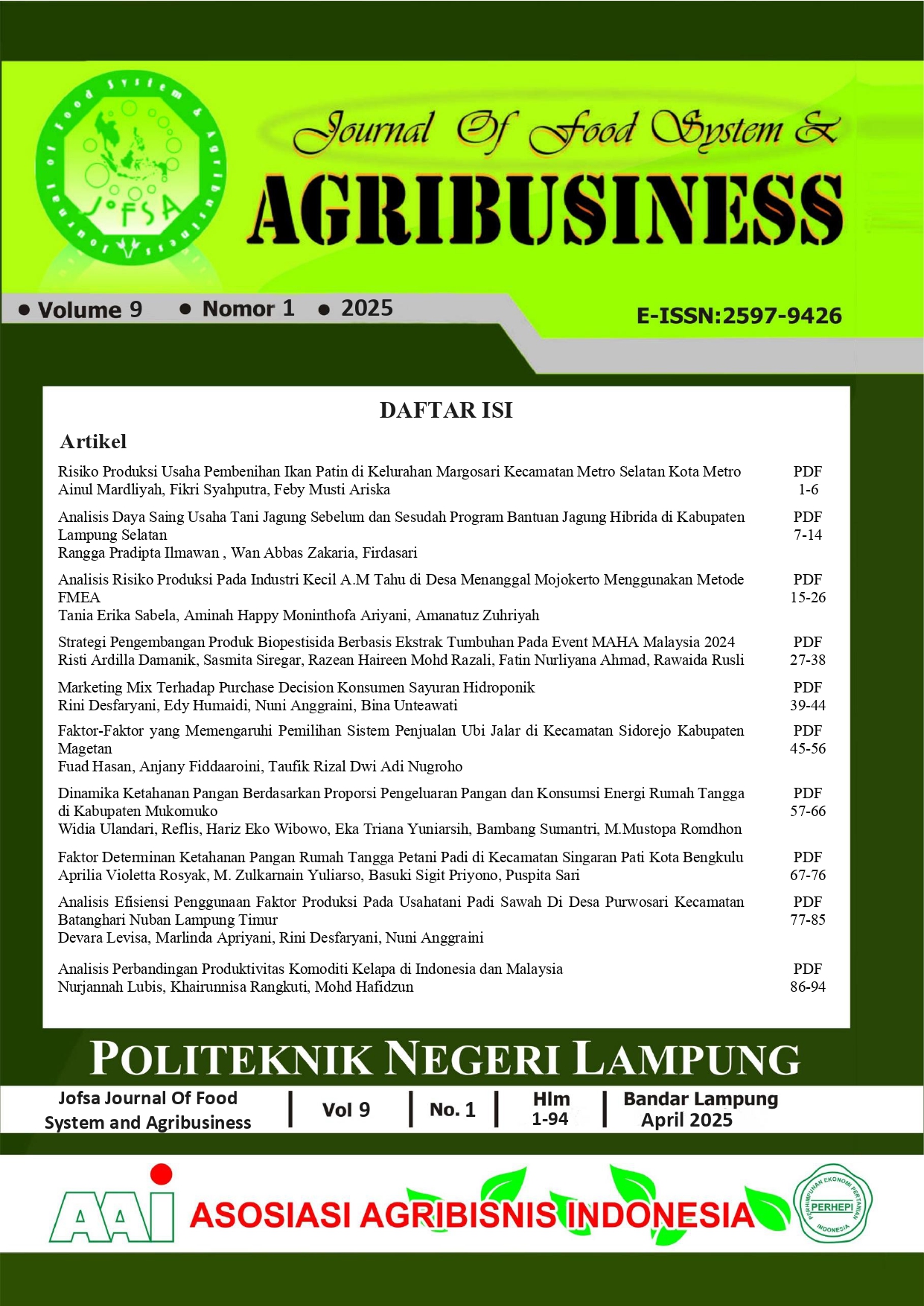
Analisis Efisiensi Penggunaan Faktor Produksi Pada Usahatani Padi Sawah di Desa Purwosari Kecamatan Batanghari Nuban Lampung Timur
DOI:
https://doi.org/10.25181/jofsa.v9i1.4087Keywords:
Paddy, Cobbdouglass, Allocative EfficiencyAbstract
This research discusses the efficiency of using production factors in lowland rice farming in Purwosari Village, Batanghari Nuban District, East Lampung. Rice productivity from 2018- 2019 experienced fluctuations. The highest productivity occurred in 2018 at 6.25 tons per hectare, then decreased to 4.59 tons per hectare in 2019. The productivity fluctuations that occur are an indication of the use of production factors that are not yet optimal in Batanghari Nuban District. Production factors that have a significant influence in rice farming are land area (X1) with a significant value of 0.00<0.05, seeds (X2) with a significant value of 0.000<0.05, urea (X3) with a significance of 0.027<0, 05, while npk (X4) significance 0.583>0.05, pesticide (X5) significance 0.697>0.05, labor (X6) significance 0.919>0.05, are production factors that do not significantly influence rice production in the village Purwosari. Allocative efficiency analysis of the use of production factors, namely seeds in rice farming, has an NPMxi/Pxi value of 22.31>1, meaning that the use of seeds is not yet efficient, to achieve efficiency the seed variable needs to be increased. Allocative efficiency analysis of the use of production factors, namely urea, in rice farming has an NPMxi/Pxi value of 5.5>1, meaning that the use of urea is not yet efficient, to be efficient the use of urea needs to be increased. and the analysis of allocative efficiency on HOK has an NPMxi/Pxi value of 1.474 > 1, meaning that the use of Hok is still not efficient and the use of HOK needs to be increased.
Downloads
References
Apriyani, Marlinda.; Saty, Fadila Marga.; Desfaryani, Rini.; Fitriani.; Trisnanto, Teguh Budi.; Sutarni.; Berliana, Dayang.; Fitri, A. (2021). Pelatihan Pengemasan Produk Olahan Pangan Pada SMKN 1 Negeri Besar Way Kanan. Jurnal Pengabdian Nasional, 2(2), 94–100.
Desfaryani, Rini; Hartoyo, S; Anggraeni, L. (2016). Permintaan Buah-Buahan Rumahtangga Di Propinsi Lampung. Jurnal Agribisnis Indonesia, 4(2), 137–148.
Desfaryani, R., Humaidi, E., & Anggraini, N. (2023). Measurement Of Willingness To Pay Level Of Organic Rice Consumers In Bandar Lampung City. Agriprimatech, 6(1), 69–74.
Gujarati, D. (2003). Ekonomi Dasar (terjemahan oleh Sumarno Zain). Edisi VII. Erlangga: Jakarta.
Herlina, E. Y., & Gafur, S. (2019). Analisis Efisiensi Penggunaan Faktor-Faktor Produksi Usahatani Padi Sawah Di Lahan Rawa Pasang Surut Desa Sungai Kakap Kecamatan Sungai Kakap Kabupaten Kubu Raya. Jurnal Social Economic of Agriculture, 8(1).
Lubis, Z., & Rahman, A. (2012). Analisis Faktor-faktor Yang Mempengaruhi Produksi Jagung Hibrida Di Kecamatan Sei Bingei Kabupaten Langkat.
Primalasari, I., & Puspitasari, M. S. (2021). Analisis Pendapatan Usahatani Padi Organik dan Kontribusinya Terhadap Pendapatan Rumahtangga Di Kecamatan BTS Ulu Kabupaten Musi Rawas. Journal of Food System and Agribusiness, 5(2), 99–106. https://doi.org/10.25181/jofsa.v5i2.1959
Saeful. (2013). Analisis Faktor-Faktor Yang Mempengaruhi Produksi dan Produktivitas Padi di Kecamatan Gantarang Kabupaten Bulukumba.
Sutarni, S., & Apriyani, M. (2011). The Factors which Influence Corn Production. Jurnal Ilmiah ESAI, 5(3).
Downloads
Published
How to Cite
Issue
Section
License
Copyright (c) 2025 Journal of Food System and Agribusiness

This work is licensed under a Creative Commons Attribution-NonCommercial 4.0 International License.
Authors who publish with Journal of Food System and Agribusiness (JoFSA) agree to the following terms:
Authors retain copyright and grant the Journal of Food System and Agribusiness (JoFSA) right of first publication with the work simultaneously licensed under a Creative Commons Attribution License (CC BY-SA 4.0) that allows others to share (copy and redistribute the material in any medium or format) and adapt (remix, transform, and build upon the material for any purpose, even commercially) with an acknowledgment of the work's authorship and initial publication in Journal of Food System and Agribusiness (JoFSA).
Authors are able to enter into separate, additional contractual arrangements for the non-exclusive distribution of the journal's published version of the work (e.g., post it to an institutional repository or publish it in a book), with an acknowledgment of its initial publication in Journal of Food System and Agribusiness (JoFSA). Authors are permitted and encouraged to post their work online (e.g., in institutional repositories or on their website) prior to and during the submission process, as it can lead to productive exchanges, as well as earlier and greater citation of published work.