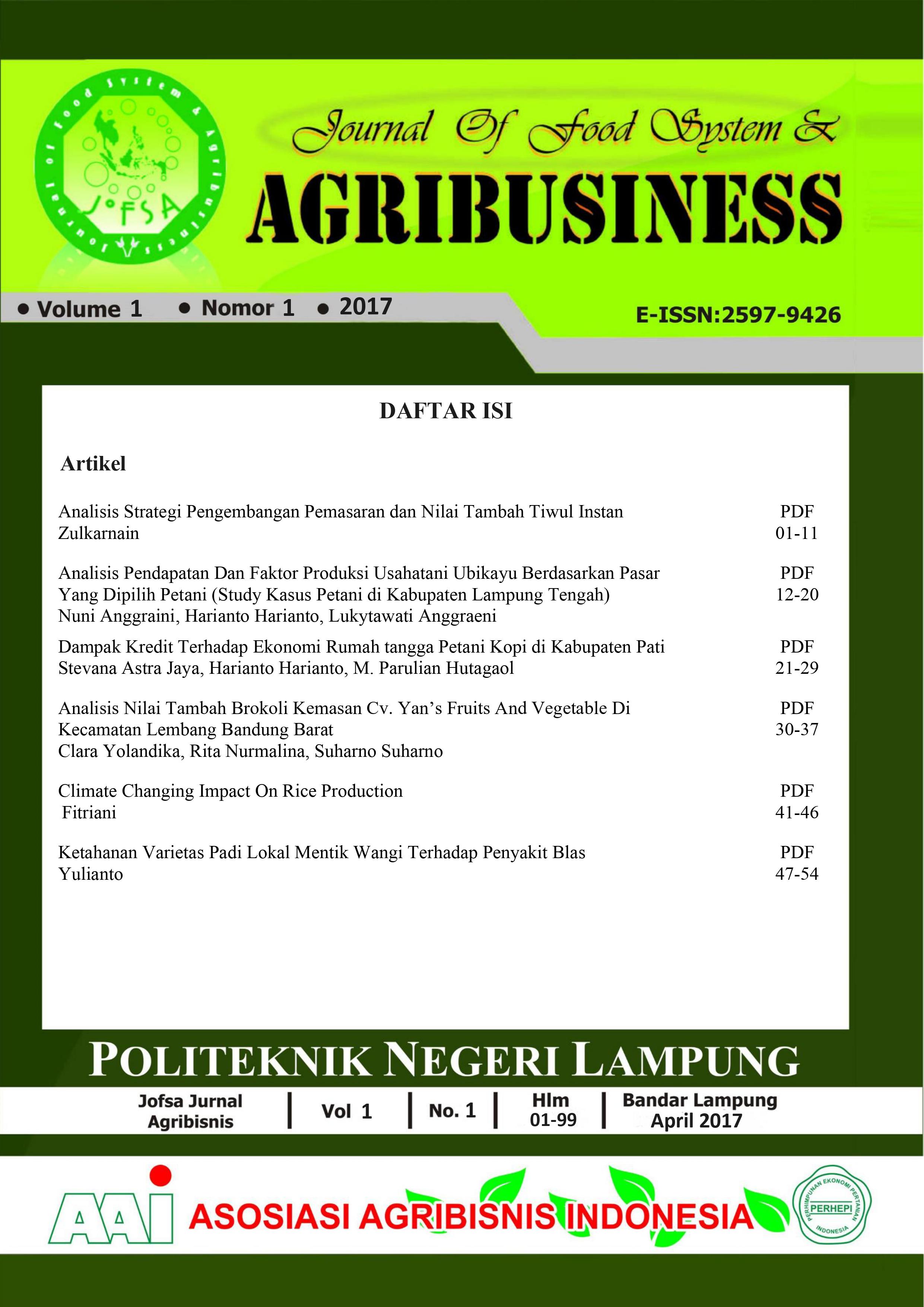
Analisis Pendapatan Dan Faktor Produksi Usahatani Ubikayu Berdasarkan Pasar Yang Dipilih Petani (Study Kasus Petani di Kabupaten Lampung Tengah)
DOI:
https://doi.org/10.25181/jofsa.v1i1.80Abstract
The success of a farm can be seen from the amount of income and a combination optimum factors of production. The objectives of this study were to analyze the cassava farm income and to identify the factors that influence the production of cassava farming in Central Lampung Regency. This study was conducted in Central Lampung Regency, Lampung Province as center of cassava production with select 78 cassava farmers. R/C ratio and Cobb Douglas Production Function analysis was used in this study. The results revealed that income cassava farmers who sell their crops to the plant is greater than the income of farmers who sell to traders. Factors affecting on cassava production are land, seed, N fertilizer, K fertilizer and marketing channels dummy. Based on the value of return of scale in the amount of 1.30, implying that the cassava farming in Central Lampung Regency is located on Increasing Return to Scale (IRS). The income of cassava farming can be enhanced through the harvesting of cassava as recommended so as to reduce the magnitude of rafaksi.
Â
Keywords : Production, farming, cassava, income, cobb-douglasDownloads
References
Aboki, E., Jongur A.,A.,U., Onuand, J.,I., Umaru, I., I. 2013. Analysis of technical, economic and allocative efficiencies of cassavaproduction in Taraba State, Nigeria. Journal of Agriculture and Veterinary Science. 5 (3) :19-26.
Addinirwan L. 2014. Analisis Pendapatan dan Efisiensi Teknis Usahatani Ubikayu Desa Galuga Kecamatan Cibungbulang Kabupaten Bogor. Skripsi. Institut Pertanian Bogor. Bogor.
Abednego. 2008. Analisis Pengaruh Saluran Pemasaran dan Harga Terhadap Pendapatan Petani Jeruk Manis di Daerah Sukanalu Kecamatan Barusjahe Kabupaten Karo. Tesis. Universitas Sumatra Utara. Medan.
Arief et al. 2012. Pengembangan Pemanfaatan Ubikayu di Provinsi Lampung Melalui Pengolahan Tepung Ubikayu dan Tepung Ubikayu Modifikasi. Buletin Palawija. (24) : 82-91
Badan Pusat Statistik. 2014. Statistik Indonesia . Badan Pusat Statistik. Jakarta
Badan Pusat Statistik. 2014. Lampung Dalam Angka.. Badan Pusat Statistik. Lampung
Dinas Pertanian Tanaman Pangan dan Hortikultura. 2013. Laporan Tahunan. Dinas Pertanian Tanaman Pangan dan Hortikultura. Bandar Lampung
Kementerian Pertanian. 2012. Pedoman Teknis Pengelolaan Produksi Ubikayu Tahun 2012. Kementerian Pertanian. Jakarta.
Nursan M. 2015. Efisiensi dan Daya Saing Usahatani Jagung pada Lahan Kering dan Sawah di Kabupaten Sumbawa. Tesis. Institut Pertanian Bogor. Bogor.
Ogunniyi, L., T., Ajetomobi, J., O., Fabiyi, Y., I. 2013. Technical efficiency of cassava - based cropping in Oyo State of Nigeria. Agris on-line Papers in Economics and Informatics. 5 (1) : 51-58
Soekartawi, Soeharjo A, Dillon JL, Hardaker JB. 1984. Ilmu Usahatani dan Penelitian Untuk Pengembangan Petani Kecil. UI Press. Jakarta.
Zakaria, Wan Abbas. 2000. Analisis Permintaan dan Penawaran Ubi Kayu di Propinsi Lampung. Disertasi. Institut Pertanian Bogor. Bogor.
Downloads
Published
How to Cite
Issue
Section
License
Copyright (c) 2017 Journal of Food System & Agribusiness

This work is licensed under a Creative Commons Attribution-NonCommercial 4.0 International License.
Authors who publish with Journal of Food System and Agribusiness (JoFSA) agree to the following terms:
Authors retain copyright and grant the Journal of Food System and Agribusiness (JoFSA) right of first publication with the work simultaneously licensed under a Creative Commons Attribution License (CC BY-SA 4.0) that allows others to share (copy and redistribute the material in any medium or format) and adapt (remix, transform, and build upon the material for any purpose, even commercially) with an acknowledgment of the work's authorship and initial publication in Journal of Food System and Agribusiness (JoFSA).
Authors are able to enter into separate, additional contractual arrangements for the non-exclusive distribution of the journal's published version of the work (e.g., post it to an institutional repository or publish it in a book), with an acknowledgment of its initial publication in Journal of Food System and Agribusiness (JoFSA). Authors are permitted and encouraged to post their work online (e.g., in institutional repositories or on their website) prior to and during the submission process, as it can lead to productive exchanges, as well as earlier and greater citation of published work.