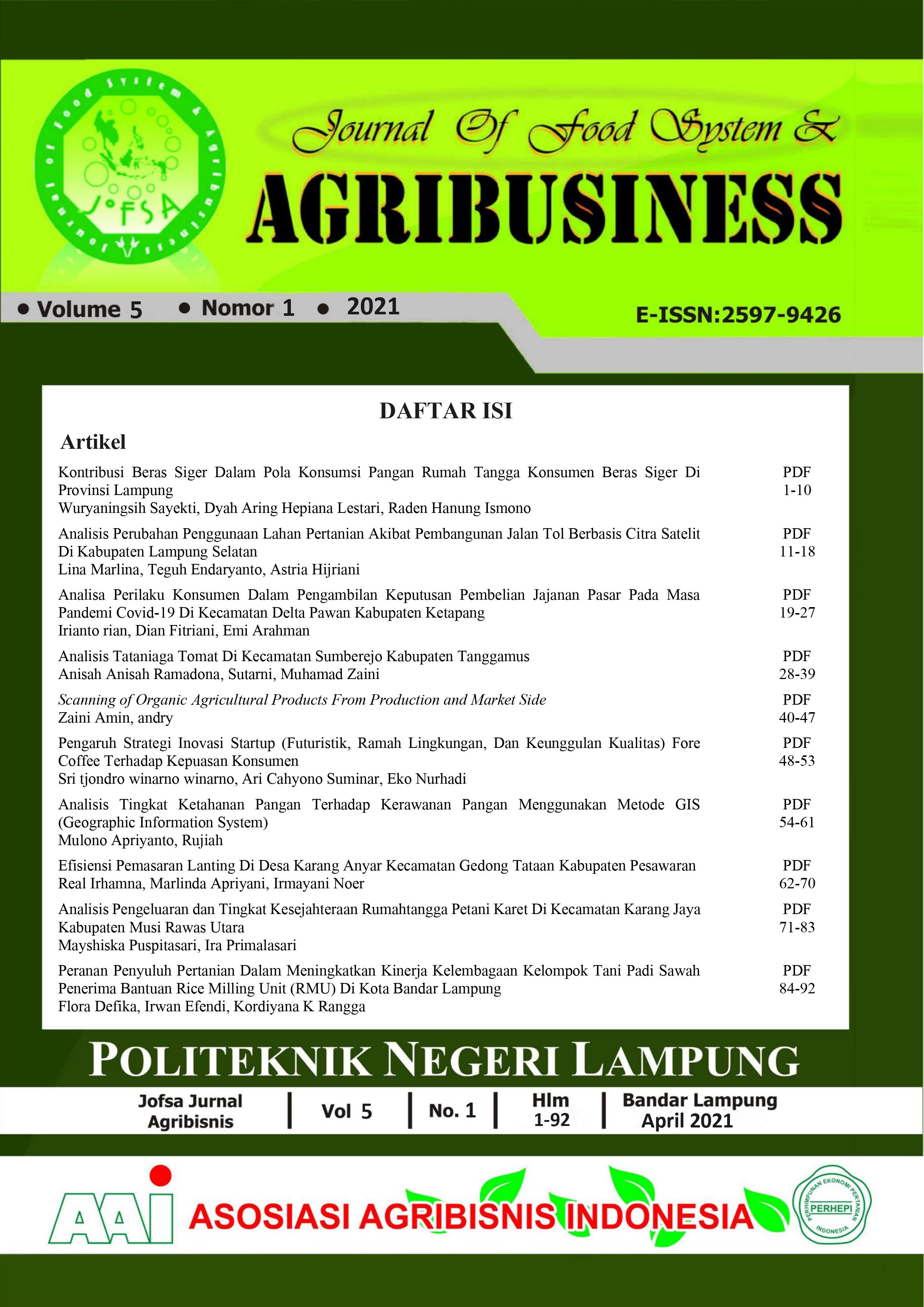
Efisiensi Pemasaran Lanting Di Desa Karang Anyar Kecamatan Gedong Tataan Kabupaten Pesawaran
DOI:
https://doi.org/10.25181/jofsa.v5i1.1986Abstract
This study aims to analyze the marketing efficiency of lanting. The research method used is a survey method. This research was conducted in Karanganyar Village, Gedong Tataan Subdistrict, Pesawaran Regency, with 37 respondents. The analysis used is the marketing channel, marketing margins, business profits, and lanting marketing efficiency. The results of the analysis show that the most efficient marketing of lanting is a marketing channel that does not involve marketing agencies, namely producers directly to the end consumers. This marketing channel is the first channel (channel 1).
Keywords: efficiency, lanting, and marketing
Downloads
References
Boneta, G. (2013) ‘Pengaruh Produk, Harga, Promosi, dan Saluran Distribusi Terhadap Keputusan Pembelian Air Minum Dalam Kemasan Merek Aqua’, Sekolah Tinggi Ilmu Ekonomi Bisnis Indonesia.
Dinas Koperasi dan UMKM (2020) Data pelaku UMKM Kabupaten Pesawaran. Provinsi Lampung.
Fitri, N. A., Apriyani, M. and Sari, A. (2017) Analisis Margin Pemasaran Cabai Rawit Merah di Kecamatan Lembang Kabupaten Bandung Barat. Politeknk Negeri Lamung.
Heriani, N., Zakaria, W. A. and Soelaiman, A. (2013) ‘Analisis Keuntungan Dan Resiko Usaha Tani Tomat di Kecamatan Sumberejo Kabupaten Tanggamus’, Universitas Lampung, 1(2).
Istiyanti, E. et al. (2015) ‘Efisiensi Pemasaran Emping Melinjo di Kabupaten Bantul Daerah Istimewa Yogyakarta’, Universitas Muhammadiyah Yogyakarta.
Khairunnisa, T., Affandi, M. I. and Suryani, A. (2018) ‘Analisis Efisiensi Pemasaran Emping Melinjo di Kelurahan Sukamaju Kecamatan Teluk Timur Kota Bandar Lampung’, Jurnal Ilmu Ilmu Agribisnis, 6(4).
Mahdalena (2016) ‘Tingkat Efisiensi Pemasaran Telur Itik Alabio dan Telur Asin di Kabupeten Hulu Sungai Utara. Provinsi Kalimantan Selatan’, Sekolah Tinggi Ilmu Pertanian Amuntai, 6(2).
Sugiyono (2013) Metode Penelitian Pendidikan. Bandung: Afabeta.
Sukandarrumidi (2008) Metodologi Penelitian Petunjuk Praktis Untuk Peneliti Pemula. Yogyakarta: Gadjah Mada University Press.
Sutarno (2014) ‘Analisis Efisiensi Pemasaran Kedelai di Kabupaten Wonogiri’, Agrineca, 14(1).
Wulandari, D., Qurniati, R. and Herwati, S. (2018) ‘Efisiensi Pemasaran Duriam (Durio zibethinus) di Desa Wisata Durian Kelurahan Sumber Agung’, Sylva Lestari, 6(2).
Zuraida and Wahyuningsih, Y. M. (2015) ‘Efisiensi Pemasaran Kacang Tanag (Arachis hypogeae L) di Kelurahan Landasan Ulin Tengah Kecamatan Landasan Ulin Kota Banjarbaru Provinsi Kalimantan Selatan’, Ziraa’ah, 40(3).
Downloads
Published
How to Cite
Issue
Section
License
Copyright (c) 2021 Journal of Food System & Agribusiness

This work is licensed under a Creative Commons Attribution-NonCommercial 4.0 International License.
Authors who publish with Journal of Food System and Agribusiness (JoFSA) agree to the following terms:
Authors retain copyright and grant the Journal of Food System and Agribusiness (JoFSA) right of first publication with the work simultaneously licensed under a Creative Commons Attribution License (CC BY-SA 4.0) that allows others to share (copy and redistribute the material in any medium or format) and adapt (remix, transform, and build upon the material for any purpose, even commercially) with an acknowledgment of the work's authorship and initial publication in Journal of Food System and Agribusiness (JoFSA).
Authors are able to enter into separate, additional contractual arrangements for the non-exclusive distribution of the journal's published version of the work (e.g., post it to an institutional repository or publish it in a book), with an acknowledgment of its initial publication in Journal of Food System and Agribusiness (JoFSA). Authors are permitted and encouraged to post their work online (e.g., in institutional repositories or on their website) prior to and during the submission process, as it can lead to productive exchanges, as well as earlier and greater citation of published work.