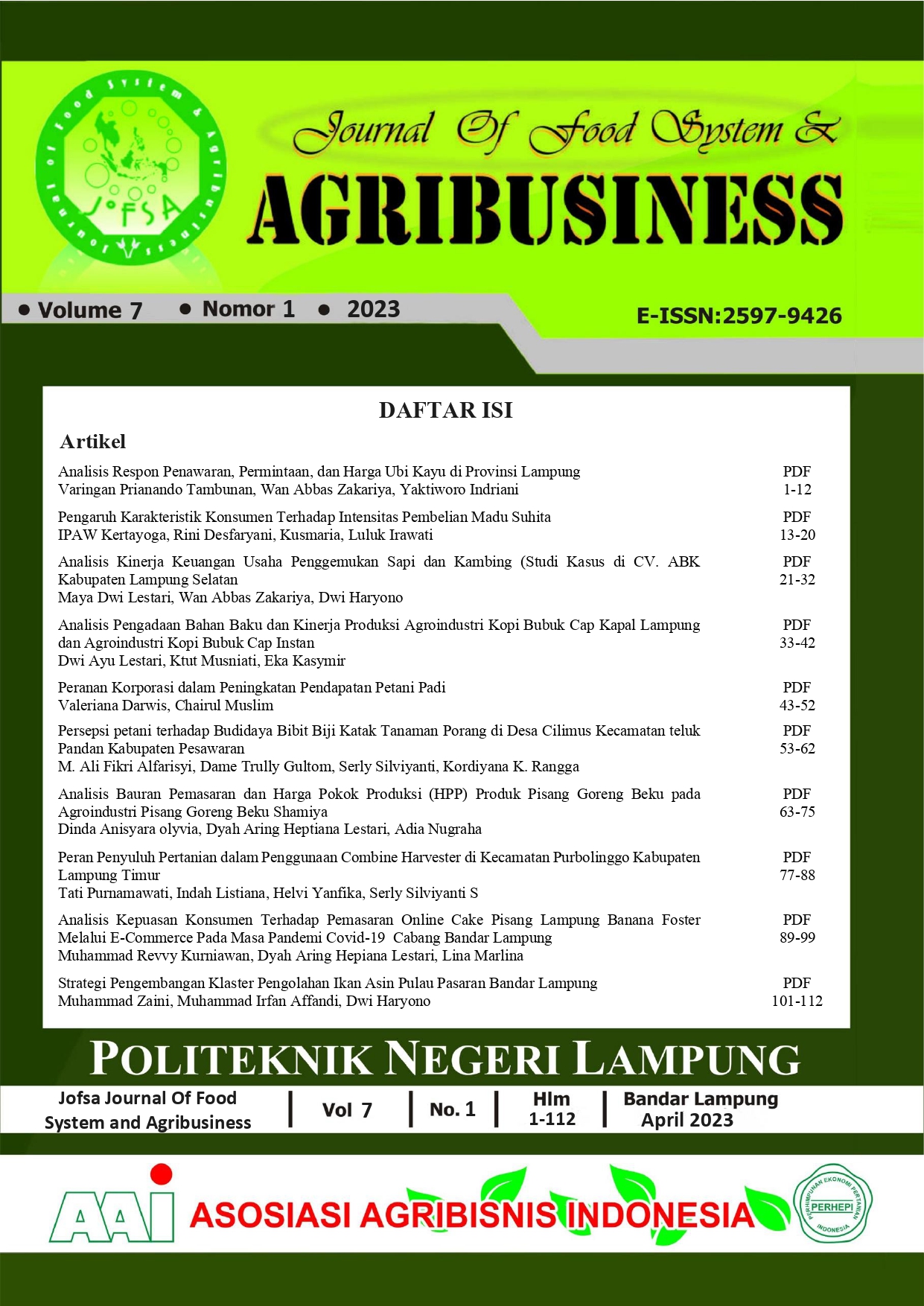
Peran Penyuluh Pertanian dalam Penggunaan Combine Harvester di Kecamatan Purbolinggo Kabupaten Lampung Timur
DOI:
https://doi.org/10.25181/jofsa.v7i1.2331Keywords:
Agricultural Extension, Combine Harvester, farmerAbstract
The use of Combine harvesters as an innovation in an effort to reduce yield loss does not always receive a good response. It is the job of the Agricultural Extension Officer, as a field implementer in the field of agriculture that is directly related, to devote all encouragement to farmers to be moved and able to change their way of thinking, work steps, and respond to innovation developments, especially the use of combine harvesters. The purpose of this research is to determine the role of agricultural extension workers in the use of combine harvesters. The research was conducted in Purbolinggo District, East Lampung Regency. The data in this study were taken in November 2021. The sample or respondents in this study consisted of 30 farmers in Purbolinggo District who were selected by purposive sampling. While the research method used is a survey, data analysis is done both descriptively and quantitatively. From the results of the research conducted, it shows that the role of agricultural extension workers as initiators, motivators, and facilitators is in the high category. In addition, there is a correlation between the role of the agricultural extension worker as an initiator, the role of the extension worker as a motivator, and the role of the worker as a facilitator on the quality, quantity of yield, time, cost, farmer's income, and environmental friendliness, except for the role of the extension worker as an initiator on the quality of the crops.
Downloads
References
(Balitbangtan). 2019. Diskripsi Varietas Unggul Baru Padi 2019. Balai Besar Penelitian Padi. Kementerian Pertanian. Sukamandi
(BPS). 2020. Kabupaten Lampung Timur dalam Angka. Badan Pusat Statistik Kabupaten Lampung Timur. C.V. Jaya Wijaya. Lampung Timur.
Dahu, B, Taena W, dan Joka, U (2022). Peranan Penyuluh Pertanian Terhadap Produktivitas Usahatani Padi Sawah di Kecamatan Kobalima Kabupaten Malaka. Jurnal Penelitian Pertanian Terapan 22 (1), 67-81. http://dx.doi.org/10.25181/jppt.v17i3.2176
Denny, R. 1997. Sukses Memotivasi. Gramedia Pustaka Utama. Jakarta.
Dewi,M.M., Utami, B.W., dan Ihsaniyat, H. (2016). Motivasi Petani Berusahatani Padi (Kasus di Desa Gunung Kecamatan Simo Kabupaten Boyolali). Agrista 4(3), 104 - 114.
Durroh, B. (2020). Efektivitas Penggunaan Mesin Panen pada Pemanenan Padi di Kabupaten Bojonegoro. SINTA Journal 1(1). 2020:7–13
Fitriani, Sutarni, Haryono, D., Ismono, H., & Lestari, D. A. H. (2017). Pertanian Perdesaan Lampung: Peluang dan Tantangan. JoFSA (Journal of Food System & Agribusiness), 1(2), 43–52.
Intiaz, L. F., Prasetyo, A. S., & Prayoga, K. (2022). Tingkat Adopsi Inovasi Teknologi Combine Harvester. Forum Agribisnis (Agribusiness Forum) 12(2), 113–125.
Jannah, A.R., Toiba, H., dan Andriatmoko, N.D. (2019). Niat Adopsi Petani dalam Menggunakan TeknologiCombine Harvester. Jurnal Habitat 30(2), 71-78.
Kartasapoetra, A.G. 1991. Teknologi Penyuluhan Pertanian. Bumi Aksara. Jakarta.
Kasiram, M. 2008. Metode Penelitian Kuantitatif-Kualitatif. UIN-Malang Press. Malang.
Kunuti, S.A., Rauf, A., Saleh, Y. (2020). Perbandingan Hasil Panen Usahatani Padi Sawah Menggunakan Combine Harvester dan Sistem Bawon di Kabupaten Gorontalo. Jambura Agribisnis Journal 1, 63-70.
Listiana, I., Rangga K.K., Anggoroseto P., dan Purwatiningsih N.P. (2019). Respons Petani Terhadap Penggunaan Combine Harvester Pada Waktu Panen Padi Sawah Di Kabupaten Pringsewu Provinsi Lampung. Jurnal Pengkajian dan Pengembangan Teknologi Pertanian. 23(3), 259-269.
Maksudi, I., Indra, I., dan Fauzi, T. (2018). Determinan Penggunaan Mesin Combine Harvester Dan Dampaknya Terhadap Efektivitas Penggunaan Mesin Panen (Combine Harvester) Pada Pemanenan Padi di Kabupaten Pidie Jaya. Jurnal Ilmiah Mahasiswa Pertanian 3(1), 140-146.
Molenaar, R. (2020). Panen dan Pascapanen Padi, Jagung dan Kedelai. Eugenia 26 (1), 17-28.
Purwantini, T.B., dan Susilowati, S.H. (2018). Dampak Penggunaan Alat Mesin Panen Terhadap Kelembagaan Usaha Tani Padi. Analisis Kebijakan Pertanian 16 (1), 73-88.
Puryantoro, Rozy, F. (2020). Identifikasi Motivasi Petani Dalam Melakukan Usahatani Tembakau Di Kabupaten Situbondo. Mimbar Agribisnis. Jurnal Pemikiran Masyarakat Ilmiah Berwawasan Agribisnis 6(1), 238-245.
Romansyah, E., Wahyuddin, N., dan Nazaruddin, N. (2018). Uji Performansi Mesin Pemanenan dan Perontok Type Mobil. Jurnal Agrotek Ummat 5(1), 55-59.
Sandhi, N.I.LA.P.,Putra,I.G.S.A., dan Astiti, N.W.S. (2020). Peran Penyuluh dalam Memotivasi Petani Berusahatani Cabai di Desa Guwang, Kecamatan Sukawati, Gianyar. Jurnal Agribisnis dan Agrowisata 9(3), 336-344.
Siadina, S., Kandatong,H., dan Astuti, I. (2019). Analisis Pendapatan Petani Padi Sawah dengan Menggunakan Teknologi Alat Pasca Panen di Desa Sidorejo Kecamatan Wonomulyo Kabupaten Polewali Mandar. Agrovital: Jurnal Ilmu Pertanian 4(1), 30-36.
Umar, S.2006. Peningkatan Efisiensi Alat dan Mesin Pertanian pada Usahatani Padi di Lahan Rawa. Prosiding Seminar Nasional Inovasi Teknologi untuk Mendukung Revitalisasi Pertanian Melalui Pengembangan Agribisnis dan Ketahanan Pangan (448-456). 22-23 November 2006. Manado. Badan Litbang Pertanian.
Umar, S., dan Alihamsyah, T.2014. Mekanisasi Pertanian Untuk Produksi Padi di Lahan Rawa Pasang Surut. Balai Penelitian Lahan Rawa. Kementerian Pertanian. http://repository.pertanian.go.id/handle/123456789/8335. Diakses 26-11-2021.16.36.
Winardi, J. 2004. Motivasi dan Pemotivasian dalam Manajemen. Raja Grafindo Perkasa: Jakarta.
Wira. 2020. Mesin Indo Combine Harvester Efisiensi Tenaga Kerja. Badan Litbang Pertanian Kementerian Pertanian.https://www.litbang.pertanian.go.id/info-teknologi/4134/. diakses 27-11-2021.15.30
Zainuddin, A.H. 2016. Metode Penelitian Hukum. Sinar Grafika Offset. Jakarta.
Downloads
Published
How to Cite
Issue
Section
License
Copyright (c) 2023 Journal of Food System and Agribusiness

This work is licensed under a Creative Commons Attribution-NonCommercial 4.0 International License.
Authors who publish with Journal of Food System and Agribusiness (JoFSA) agree to the following terms:
Authors retain copyright and grant the Journal of Food System and Agribusiness (JoFSA) right of first publication with the work simultaneously licensed under a Creative Commons Attribution License (CC BY-SA 4.0) that allows others to share (copy and redistribute the material in any medium or format) and adapt (remix, transform, and build upon the material for any purpose, even commercially) with an acknowledgment of the work's authorship and initial publication in Journal of Food System and Agribusiness (JoFSA).
Authors are able to enter into separate, additional contractual arrangements for the non-exclusive distribution of the journal's published version of the work (e.g., post it to an institutional repository or publish it in a book), with an acknowledgment of its initial publication in Journal of Food System and Agribusiness (JoFSA). Authors are permitted and encouraged to post their work online (e.g., in institutional repositories or on their website) prior to and during the submission process, as it can lead to productive exchanges, as well as earlier and greater citation of published work.