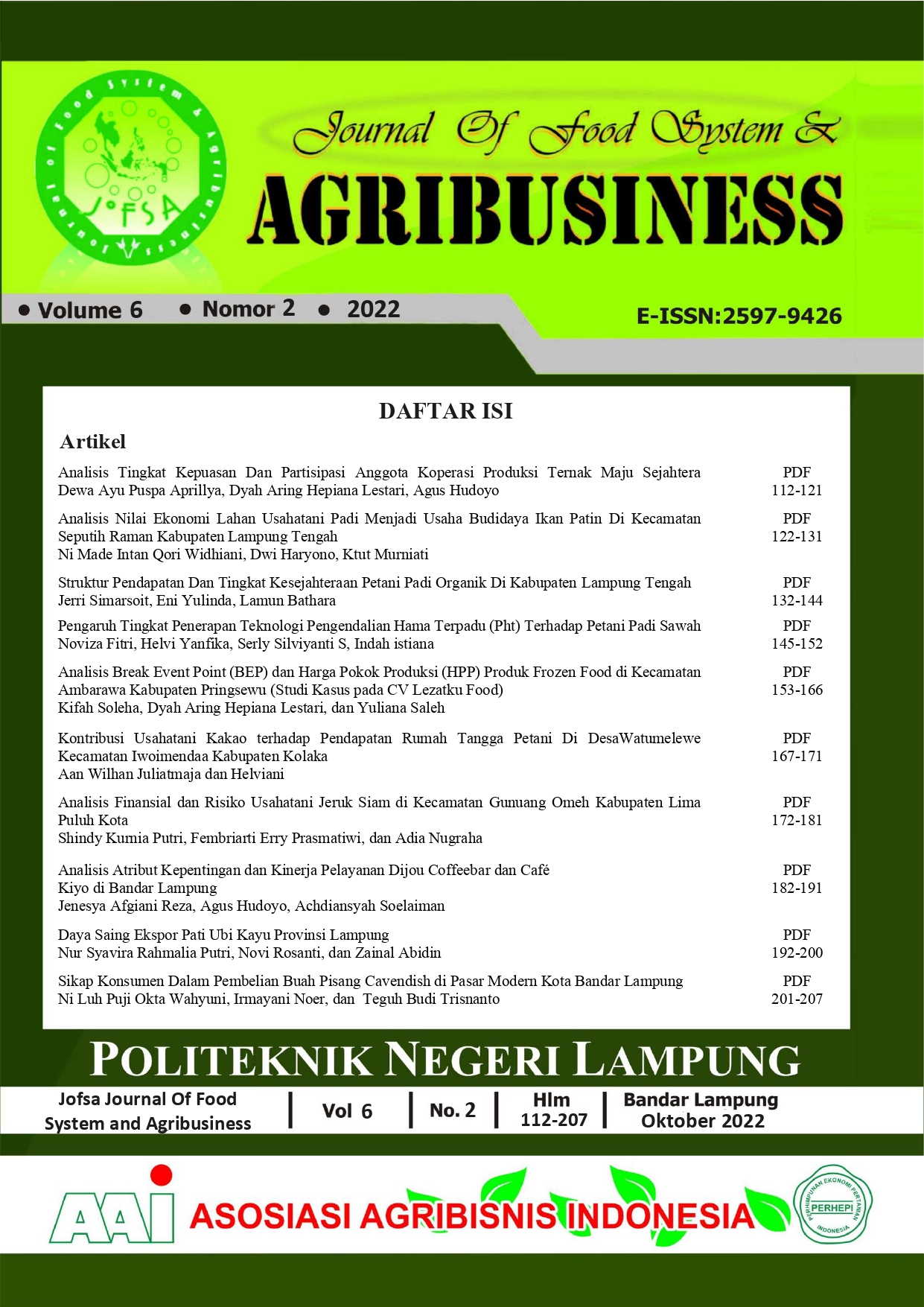
Daya Saing Ekspor Pati Ubi Kayu Provinsi Lampung
DOI:
https://doi.org/10.25181/jofsa.v6i2.2256Keywords:
Competitiveness, ISP, Porter’s diamond model, RCAAbstract
This study analyze comparative and competitive advantages export of Lampung Province
cassava starch. The data used secondary time series data for period 2009-2020. The method
used is quantitative descriptive method. Data analyses used revealed comparative advantage
(RCA), the trade specialization index (ISP), and the Porter's diamond model. Research was
conducted on March-June 2021. The result showed that Lampung Province cassava starch
has comparative advantage or strong competitiveness with an average value RCA 16,92. The
ISP value shows a result of 0,69 or in a growth position and Lampung Province tends to be
an exporter of cassava starch. In terms of competitive advantage Lampung Province has
weak competitiveness because the main component do not supported each other.
Downloads
References
Anggraini, N., Harianto, H., & Anggraeni, L. (2017). Analisis Pendapatan Dan Faktor Produksi Usahatani Ubikayu Berdasarkan Pasar Yang Dipilih Petani (Study Kasus Petani di Kabupaten Lampung Tengah). Journal of Food System & Agribusiness, 1(1), 12–20. https://doi.org/10.25181/jofsa.v1i1.80
Asriani, P. S. (2010). PERDAGANGAN UBIKAYU INDONESIA DI PASAR DUNIA (Indonesia Cassava
Trade in World Market). Jurnal AGRISEP, 9(2), 184–196. https://doi.org/10.31186/jagrisep.9.2.184196
Asriani, P. S. (2011). Analisis Daya Saing Ekspor Ubi Kayu Indonesia. J. Agroland, 18(1), 65–70.
Badan Pusat Statistik. (2020). Statistik Indonesia 2020. Indonesia: Badan Pusat Statistik.
Basri, F., & Munandar, H. (2010). Dasar-Dasar Ekonomi Internasional: Pengenalan dan Aplikasi Metode Kuantitatif. Jakarta: Kencana.
Dinas Ketahanan Pangan Tanaman Pangan dan Hortikultra Provinsi Lampung. (2017). Ada Ubi Kayu yang Hasilkan 102 Ton Ha, Cocok untuk Pangan Alternatif Saat Pandemi Covied 19.
Dinas Ketahanan Pangan Tanaman Pangan dan Hortikultra Provinsi Lampung. (2019). Usulan Tenaga Harian Lepas Lingkup Kementerian Pertanian menjadi ASN-PPPK Penyuluh Pertanian.
Diphayana, W. (2018). Perdagangan Internasional. Yogyakarta: Deepublish.
Fitriana, M. D., Zakaria, W. A., & Kasymir, E. (2019). Analisis Efisiensi Produksi Usahatani Ubi Kayu Di Kecamatan Natar Kabupaten Lampung Selatan. Jurnal Ilmu-Ilmu Agribisnis, 7(1), 22.
https://doi.org/10.23960/jiia.v7i1.22-27
Jannah, E. M. (2012). Kabupaten Lampung Tengah Farm Profit Analysis and Houschold ’ S Income Distribution of Cassava Farmers in Tapioca Agroindustry. Litbang Pertanian, 95–105.
Kristian. (2016). Determinan Produksi, Konsumsi, dan Harga Ubi Kayu. Jurnal Kelitbangan, 3(1), 1–23.
Manihuruk, E. M., Harianto, H., & Kusnadi, N. (2018). Analisis Faktor Yang Memengaruhi Petani Memilih Pola Tanam Ubi Kayu Serta Efisiensi Teknis Di Kabupaten Lampung Tengah. Jurnal AGRISEP : Kajian Masalah Sosial Ekonomi Pertanian Dan Agribisnis, 17(2), 139–150.
https://doi.org/10.31186/jagrisep.17.2.139-150
Natanegara, R. P. (2016). Analisis Daya Saing Ubi Kayu Olahan di Pasar Internasional. Jakarta: Skripsi. Universitas Islam Negeri Syarif Hidayatullah.
Piyachomkwan, K., & Tanticharoen, M. (2011). Cassava Industry in Thailand Prospects. The Journal of the Royal Institute of Thailand, 3, 160–170.
Prabowo, I. W. H. B., Haryono, D., & Affandi, M. I. (2015). STRATEGI PENGEMBANGAN
USAHATANI UBI KAYU (Manihot utilissima) DI KECAMATAN MENGGALA KABUPATEN
TULANG BAWANG. Jurnal Ilmu-Ilmu Agribisnis, 3 (1), 1–9.
Pramesti, F. S., Rahayu, E. S., & Agustono, A. (2018). Analisis Daya Saing Ubi Kayu Indonesia Di Pasar Internasional. SEPA: Jurnal Sosial Ekonomi Pertanian Dan Agribisnis, 14(1), 1.
https://doi.org/10.20961/sepa.v14i1.21034
Putri, V. A. (2021). Kelayakan Usaha Industri Tepung Tapioka Rakyat (ITTARA) Rukun Santoso di
Kabupaten Lampung Timur. Lampung: Skripsi. Universita Lampung.
Sabaruddin, S. (2014). Perkembangan Daya Saing Ekspor Ri-China Selama Periode 1985-2010: Suatu Pelajaran Bagi Indonesia. Buletin Studi Ekonomi, 18(2), 153–175.
Sari, A. P., Ismono, R. H., & Adawiyah, R. (2020). Analisis Pendapatan, Persepsi, Dan Minat Petani Dalam Berusahatani Ubi Kayu Di Kecamatan Sukadana Kabupaten Lampung Utara. 8(3), 490–495.
Suryana, A. (2007). Kebijakan dan program penelitian mendukung tercapainya swasembada kedelai dan ubi kayu. Inovasi Teknologi Kacang-Kacangan Dan Umbi-Umbian Mendukung Kemandirian Pangan Dan Kecukupan Energi, 1–15.
Tambunan, T. (2004). Perdagangan Internasional dan Neraca Pembayaran. Jakarta: PT. Pustaka LP3ES.
Yi, F. J., Munandar, J. M., & Irwanto, A. K. (2019). Analisis Daya Saing dan Strategi Ekspor Singkong Olahan Indonesia ke China. Jurnal Manajemen Dan Organisasi, 9(2), 91–101.
Downloads
Published
How to Cite
Issue
Section
License
Copyright (c) 2022 Journal of Food System and Agribusiness

This work is licensed under a Creative Commons Attribution-NonCommercial 4.0 International License.
Authors who publish with Journal of Food System and Agribusiness (JoFSA) agree to the following terms:
Authors retain copyright and grant the Journal of Food System and Agribusiness (JoFSA) right of first publication with the work simultaneously licensed under a Creative Commons Attribution License (CC BY-SA 4.0) that allows others to share (copy and redistribute the material in any medium or format) and adapt (remix, transform, and build upon the material for any purpose, even commercially) with an acknowledgment of the work's authorship and initial publication in Journal of Food System and Agribusiness (JoFSA).
Authors are able to enter into separate, additional contractual arrangements for the non-exclusive distribution of the journal's published version of the work (e.g., post it to an institutional repository or publish it in a book), with an acknowledgment of its initial publication in Journal of Food System and Agribusiness (JoFSA). Authors are permitted and encouraged to post their work online (e.g., in institutional repositories or on their website) prior to and during the submission process, as it can lead to productive exchanges, as well as earlier and greater citation of published work.