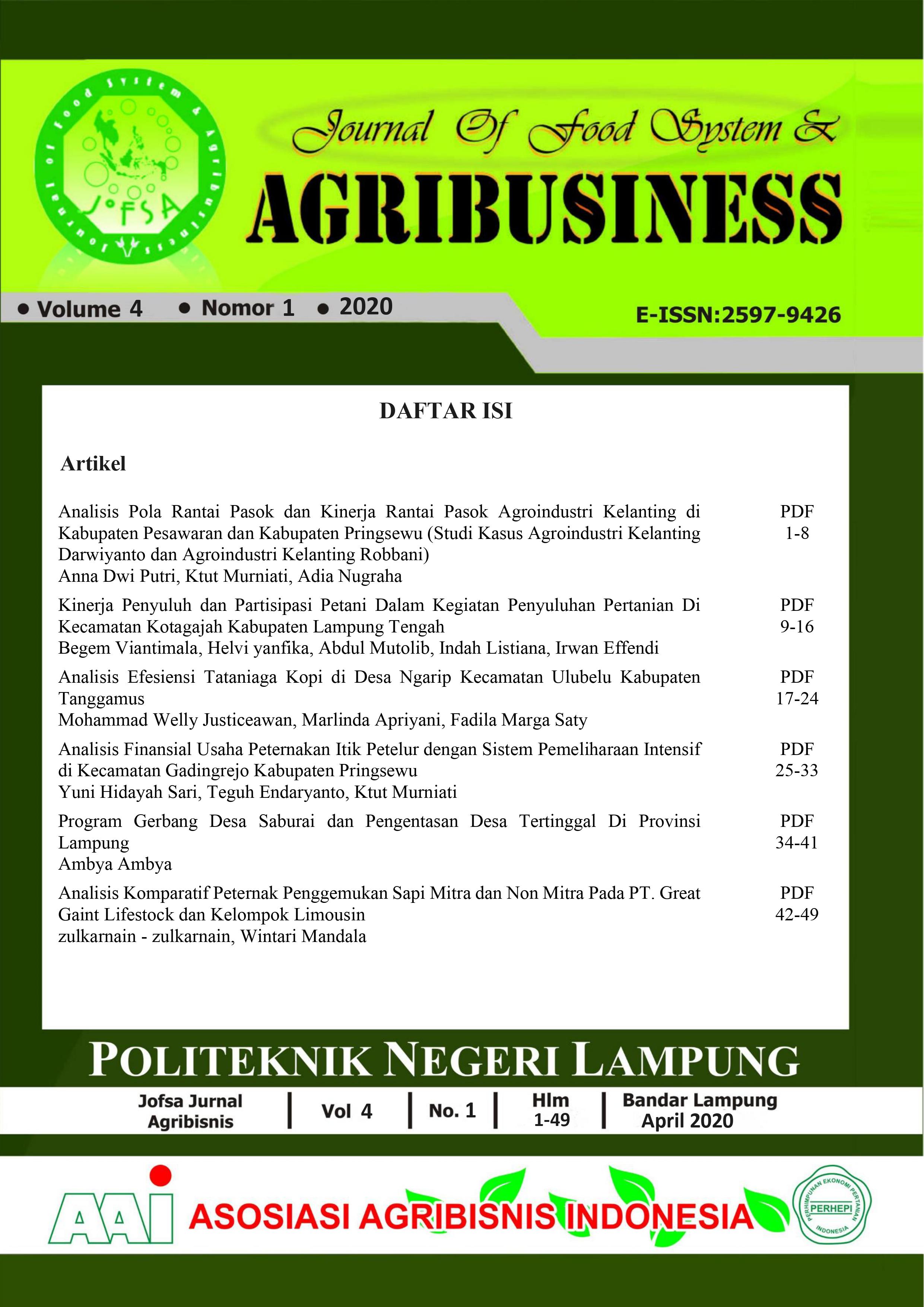
Program Gerbang Desa Saburai dan Pengentasan Desa Tertinggal Di Provinsi Lampung
DOI:
https://doi.org/10.25181/jofsa.v4i1.1602Abstract
This study aims to evaluate and analyze the Saburai Village Gate Program implemented by the Lampung provincial government in 2015-2018 with the aim of alleviating underdeveloped villages. This program is expected to be a model for improving the status of the village based on empowerment. The method used in this research is panel data analysis using significance tests, and the Random Effect Model (REM) is the best model to use. The results obtained show that the variable of community direct assistance and non-government funding has a negative and significant effect on the number of disadvantaged villages. Where the increase in direct assistance from communities and non-governmental organizations is able to reduce the number of underdeveloped villages. In the future, this model can be developed as a tool of local government policy in order to improve public services by providing rural infrastructure.
Keywords: Community Direct Aid, Self-Help Funds, Random Effect Model.
Downloads
References
Adisasmita, Rahardjo. 2006. Membangun Desa Partisipatif. Makassar: Graha Ilmu.
Ali, Mohammad. 2009. Pendidikan untuk Pembangunan Nasional, Menuju Bangsa Indonesia yang Mandiri Dan Berdaya Saing Tinggi, Jakarta :Grasindo.
Alamsyah, M. N. 2011. Memahami perkembangan desa di indonesia. ACADEMICA Fisip Untad, 03(02), 647–660.
Badan Perencanaan Pembangunan Nasional. 2004. Tata cara Perencanaan Pengembangan Kawasan Untuk Percepatan Pembangunan Daerah. Direktorat Pengembangan Kawasan Khusus dan Tertinggal. Jakarta: Bappenas
Mahendra, P. B. P. 2017. Analisis Pengaruh Implementasi Program Nasional Pemberdayaan Masyarakat Mandiri Perkotaan (PNPM MP) Terhadap Produktivitas Kerja Dan Kesejahteraan. 3, 1019–1048.
Mohi, W. K., Djibu, R., & Dunggio, Y. 2017. Peran Masyarakat dalam Program Nasional Pemberdayaan Masyarakat (PNPM) di Desa Bulontio Barat, Kecamatan Sumalata. Publik : (Jurnal Ilmu Administrasi), 6(1), 49. https://doi.org/10.31314/pjia.6.1.49-57.2017
Peraturan Gubernur Provinsi Lampung. nomor 37 tahun 2015 tentang Program Membangun Desa Sai Bumi Ruwa Jurai Tahun 2015-2019.
Peraturan Menteri Desa, Pembangunan Daerah Tertinggal, Dan Transmigrasi No.1 Tahun 2005 tentang Strategi Nasional Pembangunan Daerah Tertinggal, dan Transmigrasi
Peraturan Menteri Desa, Pembangunan Daerah Tertinggal, Dan Transmigrasi No.3 Tahun 2015 tentang Petunjuk Teknis Penentuan Indikator Daerah Tertinggal secara Nasional
Peraturan Presiden Republik Indonesia, Penetapan Daerah Tertinggal no 131 tahun 2015, tentang Penetapan Daerah Tertinggal tahun 2015-2019
Rencana Pembangunan Jangka Menengah Nasional 2015-2019
Sjafrizal. 2008. Ekonomi Regional. Teori dan Aplikasi. Baduose Media. Padang Sumatera Barat.
Undang-Undang Republik Indonesia Nomor 6 Tahun 2014 Tentang Desa.
Downloads
Published
How to Cite
Issue
Section
License
Copyright (c) 2020 Journal of Food System & Agribusiness

This work is licensed under a Creative Commons Attribution-NonCommercial 4.0 International License.
Authors who publish with Journal of Food System and Agribusiness (JoFSA) agree to the following terms:
Authors retain copyright and grant the Journal of Food System and Agribusiness (JoFSA) right of first publication with the work simultaneously licensed under a Creative Commons Attribution License (CC BY-SA 4.0) that allows others to share (copy and redistribute the material in any medium or format) and adapt (remix, transform, and build upon the material for any purpose, even commercially) with an acknowledgment of the work's authorship and initial publication in Journal of Food System and Agribusiness (JoFSA).
Authors are able to enter into separate, additional contractual arrangements for the non-exclusive distribution of the journal's published version of the work (e.g., post it to an institutional repository or publish it in a book), with an acknowledgment of its initial publication in Journal of Food System and Agribusiness (JoFSA). Authors are permitted and encouraged to post their work online (e.g., in institutional repositories or on their website) prior to and during the submission process, as it can lead to productive exchanges, as well as earlier and greater citation of published work.