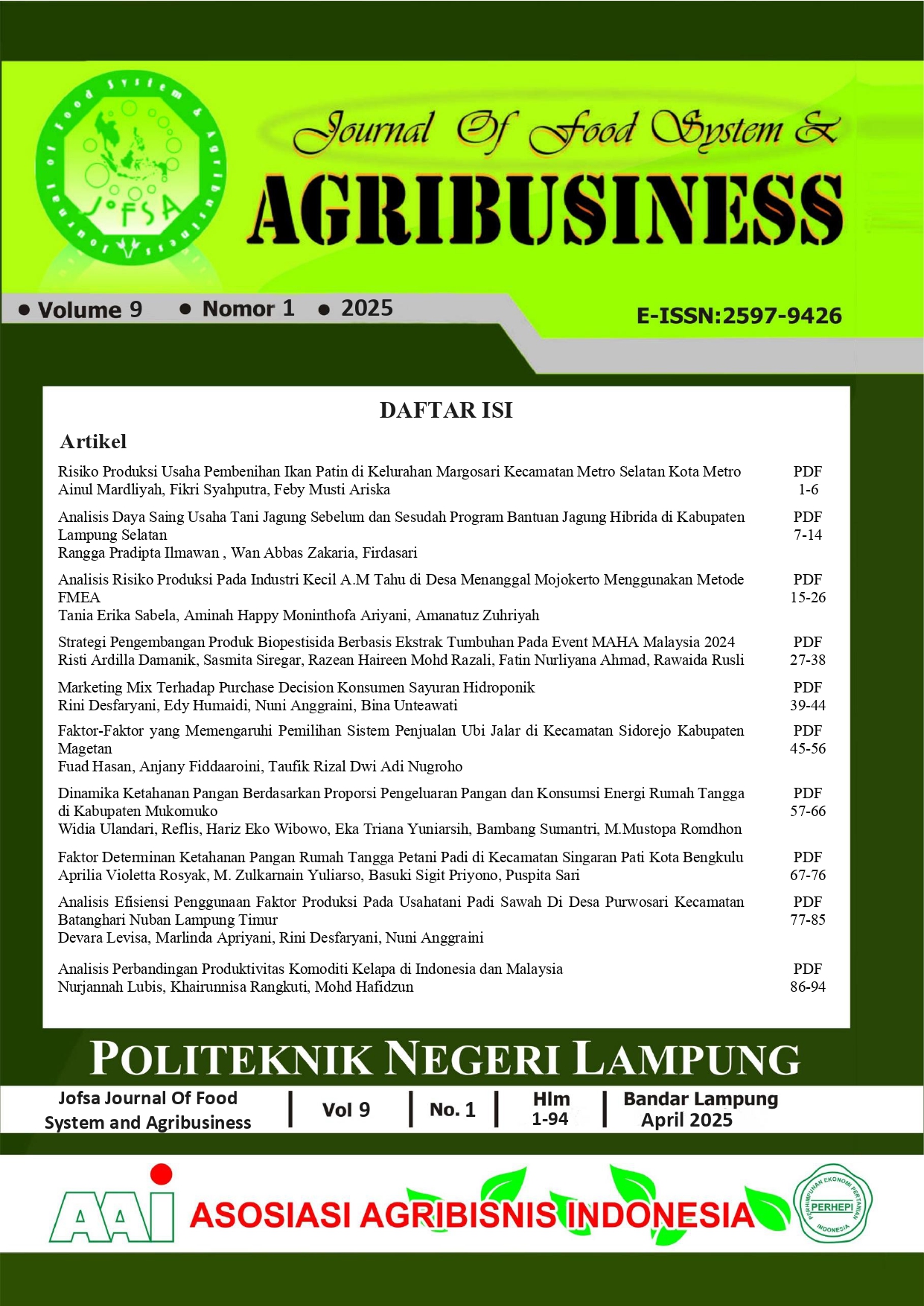
Analisis Perbandingan Produktivitas Komoditi Kelapa di Indonesia dan Malaysia
DOI:
https://doi.org/10.25181/jofsa.v9i1.4012Keywords:
Indonesia, Coconut, Malaysia, Sustainable Agriculture, ProductivityAbstract
Coconut (Cocos nucifera L.) is an agricultural commodity with a strategic role in social, cultural, and economic aspects, particularly in Indonesia and Malaysia. As the "tree of life," nearly all parts of the coconut can be utilized, giving it high economic value. Indonesia is the world's largest coconut producer, with a plantation area reaching 3.7 million hectares, while Malaysia ranks 12th with a production of 538,685 metric tons in 2018. However, low coconut productivity in both countries remains a major challenge that affects farmers' livelihoods. This study aims to analyze the comparison of coconut productivity in Indonesia and Malaysia over the period 2018–2022. The data used consists of secondary data from various official sources, such as FAO, Indonesia's Central Bureau of Statistics (BPS), and the Department of Statistics Malaysia. A descriptive analysis was conducted to identify trends in land area, production, and coconut productivity in both countries. The study results show that Indonesia’s coconut plantation area experienced a slight decline from 3,417.8 thousand hectares in 2018 to 3,340.8 thousand hectares in 2022, while Malaysia showed fluctuations with a declining trend from 83,436 hectares to 81,898 hectares over the same period. Coconut production in Indonesia remained relatively stable with a slight increase, whereas Malaysia saw production growth, reaching 604,428 tons in 2022. The productivity of coconuts in both countries is still far from its optimal potential, with Indonesia remaining around 1 ton/ha, while Malaysia showed a more significant increase. This study highlights that improving coconut productivity in both countries requires better adoption of agricultural technology, diversification of derivative products, and sustainable resource management. Strengthening both upstream and downstream sectors of the coconut industry can enhance farmers' incomes and boost global competitiveness.
Downloads
References
Akbar, A., Abdul, M., & Isman, N. (2021). Kesan rawatan pemprosesan berbeza minuman kelapa muda berkarbonat terhadap kualiti mikrobiologi. 29, 45–53.
Amalia, W., Hayati, N., & Kusrinah, K. (2018). Perbandingan Pemberian Variasi Konsentrasi Pupuk dari Limbah Cair Tahu Terhadap Pertumbuhan Tanaman Cabai Rawit (Capsicum frutescens L.). Al-Hayat: Journal of Biology and Applied Biology, 1(1), 18. https://doi.org/10.21580/ah.v1i1.2683
Dradjat B. 2020. Perkebunan kelapa sawit Indonesia masih berpotensi dikembangkan. Warta Penel Pengemb Pert. 29(2):6-7.
Evizal, R., & Prasmatiwi, F. E. (2021). Review: Pilar dan Model Pertanaman Berkelanjutan di Indonesia. Jurnal Galung Tropika, 10(1), 126–137. https://doi.org/10.31850/jgt.v10i1.721
Golden Agri Resources Ltd. 2023. Melestarikan Masa Kini, Menjamin Masa Depan. Laporan Keberlanjutan
Hidayati, J., Suryani, A., Miftah Fauzi, A., & Sugiharto. (2016). Identifikasi Revitalisasi Perkebunan Kelapa Sawit di Sumatera Utara. Jurnal Teknologi Industri Pertanian, 26(3), 255–265.
Kemala, N. (2015). Kajian Pendapatan dan Kontribusi Usahatani Kelapa (Cocos Nucifera) Terhadap Pendapatan Keluarga Petani di Kabupaten Tanjung Jabung Barat, Provinsi Jambi. Jurnal Ilmiah Universitas Batanghari Jambi, 15(3), 125–132.
Pratama, G. D., Fajarningsih, R. U., & Marwanti, S. (2022). Fakultas *1 ,. 1, 25–34.
Ramadani, R. A., Sibuea, M. B., & Rangkuti, K. (2024). AGRISAINS : Jurnal Ilmiah Magister Agribisnis Analisis Daya Saing Karet Alam Indonesia di Pasar Internasional Competitiveness Analysis of Indonesian Natural Rubber in The International Market. 6(2), 48–56. https://doi.org/10.31289/agrisains.v6i2.3866
Rangkuti, E. E., Anwar, S., Munif, A., & Siregar, I. Z. (2024). Perbandingan Pencemaran Pestisida dan Logam Berat di Beberapa Negara ASEAN: Systematic Review. Jurnal Ilmu Lingkungan, 22(2), 484–490. https://doi.org/10.14710/jil.22.2.484-490
Rangkuti, K., Ardilla, D., & Ketaren, B. R. (2022). Pembuatan Eco Enzyme Dan Photosynthetic Bacteria (Psb) Sebagai Pupuk Booster Organik Tanaman. JMM (Jurnal Masyarakat Mandiri), 6(4), 3076. https://doi.org/10.31764/jmm.v6i4.9381
Riska, R., Yamin, N. Y., & Nurdin, J. (2022). Determinan Transparansi Pelaporan Keuangan Organisasi Perangkat Daerah. Jurnal Akuntansi Dan Governance, 3(1), 77. https://doi.org/10.24853/jago.3.1.77-86
Sisca Vaulina, Khairizal, H. A. W. (2018). Efisiensi Produksi Usahatani Kabupaten Indragiri Hilir. Jurnal Agribisnis Indonesia, 6(1), 61–64.
Sowe, marten luther, Hafizrianda, Y., & Marit, elisabet leny. (2015). Jurnal Kajian Ekonomi dan Studi Pembangunan Volume II No. 3, Desember 2015. Kajian Ekonomi Dan Studi Pembangunan, II(3), 55–66.
Suhardiyono. (1997). Tanaman kelapa (cocos nucifera linn).
Sumarsono, S. (2003). Ekonomi Manajemen Sumberdaya Manusia dan Ketenagakerjaan.
Downloads
Published
How to Cite
Issue
Section
License
Copyright (c) 2025 Journal of Food System and Agribusiness

This work is licensed under a Creative Commons Attribution-NonCommercial 4.0 International License.
Authors who publish with Journal of Food System and Agribusiness (JoFSA) agree to the following terms:
Authors retain copyright and grant the Journal of Food System and Agribusiness (JoFSA) right of first publication with the work simultaneously licensed under a Creative Commons Attribution License (CC BY-SA 4.0) that allows others to share (copy and redistribute the material in any medium or format) and adapt (remix, transform, and build upon the material for any purpose, even commercially) with an acknowledgment of the work's authorship and initial publication in Journal of Food System and Agribusiness (JoFSA).
Authors are able to enter into separate, additional contractual arrangements for the non-exclusive distribution of the journal's published version of the work (e.g., post it to an institutional repository or publish it in a book), with an acknowledgment of its initial publication in Journal of Food System and Agribusiness (JoFSA). Authors are permitted and encouraged to post their work online (e.g., in institutional repositories or on their website) prior to and during the submission process, as it can lead to productive exchanges, as well as earlier and greater citation of published work.