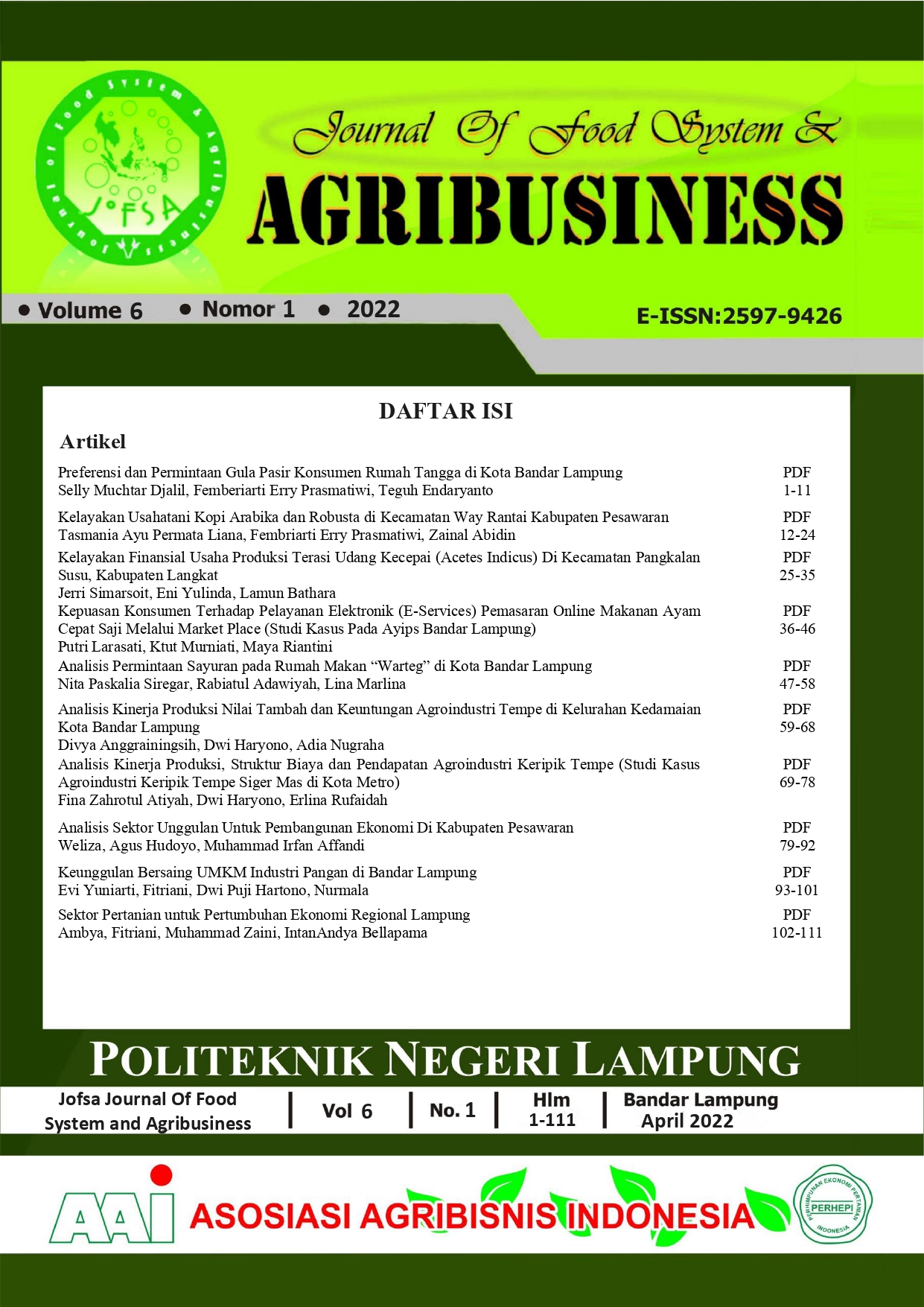
Kepuasan Konsumen Terhadap Pelayanan Elektronik (E-Services) Pemasaran Online Makanan Ayam Cepat Saji Melalui Market Place (Studi Kasus Pada Ayips Bandar Lampung)
DOI:
https://doi.org/10.25181/jofsa.v6i1.1707Keywords:
market place, e-services, IPA, customer satisfactionAbstract
Since Ayips pioneering the business, Ayips has been doing marketing online by using Instagram, Whatsapp, GoFood and GrabFood to aim to introduce the product to consumers more widely and quickly. To achieve the goal, Ayips has to fulfill the expectations of its consumers by electronic services also known as e-services. The research aims to analyze e-services performance in the online marketing of chicken Ayips by e-commerce to fulfill the expectation of its costumers. Ayips Bandar Lampung was chosen purposely. The samples used in this study were 75 people. The data was analyzed using the Importance Performance Analysis (IPA). The results showed that Ayips' willingness to answer questions and help customers if they have trouble dealing online needs improvement.
Downloads
References
Akbar, A. A. & Djatmiko, T. (2016). Pengaruh E-Service Quality Terhadap E-Customer Satisfaction Dan E-Customer Loyalty Pada Lazada.co.id : e-Proceeding of Management, 3(1), 142–150.
Alamsyah, A., Basuki, E., Prarudiyanto, A., & Cicilia, S. (2019). Diversifikasi Produk Olahan Daging Ayam. Jurnal Ilmiah Abdi Mas TPB Unram, 1(1).
Arikunto, S. (2002). Metodologi penelitian suatu pendekatan proposal. Jakarta: PT. Rineka Cipta, 16.
Ariyanti, A. (2017). Pengaruh Kualitas Pelayanan dan CRM terhadap Loyalitas Pelanggan Richeese Factory Bintara Kota Bekasi. Jurnal Pengembangan Wiraswasta, 19(3), 227-240.
David. (2018). Pengaruh E-Service Quality terhadap Loyalitas Pelanggan melalui Kepuasan Pelanggan pada Transportasi Online Grab. Petra International Journal of Business Studies, 6(2).
Harimurti, A. C., Sadeli, A. H., Utami, H. N., & Mukti, G. W. (2017). Strategi Peningkatan Kinerja Atribut Produk Sayuran Melalui Pemasaran Online Dalam Upaya Meraih Kepuasan Konsumen. Jurnal Agrosains dan Teknologi, 1(2), 47-63.
Hasanah, I. Q. (2016). Peran Media Sosial Dalam Pemasaran Pada Produk Chocofaza.
Ho, C. I., & Lee, Y. L. (2007). The development of an e-travel service quality scale. Tourism management, 28(6), 1434-1449.
Irawati, N. G. Prospek ekonomi pengembangan usaha fried chicken kaki lima di Kota Bogor.
Medah, M. (2009). E-Commerce sebagai pendukung pemasaran perusahaan. Partner, 16(1), 74-81.
Ngafifi, M. (2014). Advances in Technology and Patterns of Human Life in Socio-Cultural Perspective. Jurnal Pembangunan Pendidikan: Fondasi Dan Aplikasi, 2(1), 33-47.
Phuong, N. N. D., & Dai Trang, T. T. (2018). Repurchase intention: The effect of service quality, system quality, information quality, and customer satisfaction as mediating role: a PLS approach of m-commerce ride hailing service in Vietnam. Marketing and Branding Research, 5(2), 78.
Rasyaf, M. (1995). Pengelolaan Usaha Peternakan Ayam Pedaging.
Amjad-ur-Rehman, M., Qayyum, A., & Javed, B. (2019). The role of online shopping service quality in e-Retailing towards online shopping intention: Testing the moderation mechanism in UTAUT. Pakistan Journal of Commerce and Social Sciences (PJCSS), 13(3), 680-703.
Romdonny, J., & Rosmadi, M. L. N. (2018). Peran media sosial dalam mendukung pemasaran produk organisasi bisnis. Ikra-Ith Ekonomika, 1(2), 25-30.
Siregar, S. (2012) Statistika Deskriptif Untuk Penelitian. Jakarta: PT Raja Grafindo Persada.
Sumarwan, U. (2003). Perilaku konsumen: Teori dan penerapannya dalam pemasaran. Jakarta: Ghalia Indonesia.
Suminar, A. C., & Nurhadi, E. (2021). Pengaruh Strategi Inovasi Startup (Futuristik, Ramah Lingkungan, Dan Keunggulan Kualitas) Fore Coffee Terhadap Kepuasan Konsumen. Journal of Food System & Agribusiness, 48-53.
Supranto, J. (2006). Pengukuran tingkat kepuasan pelanggan untuk menaikkan pangsa pasar. Jakarta: Rineka Cipta, 299.
Wahyuni, N. (2014) GAP Analysis. Available at: https://qmc.binus.ac.id/2014/09/28/g-a-p-a-n-a-l-y-s-i-s/. (Accessed: 10 September 2020).
Downloads
Published
How to Cite
Issue
Section
License
Copyright (c) 2022 Journal of Food System and Agribusiness

This work is licensed under a Creative Commons Attribution-NonCommercial 4.0 International License.
Authors who publish with Journal of Food System and Agribusiness (JoFSA) agree to the following terms:
Authors retain copyright and grant the Journal of Food System and Agribusiness (JoFSA) right of first publication with the work simultaneously licensed under a Creative Commons Attribution License (CC BY-SA 4.0) that allows others to share (copy and redistribute the material in any medium or format) and adapt (remix, transform, and build upon the material for any purpose, even commercially) with an acknowledgment of the work's authorship and initial publication in Journal of Food System and Agribusiness (JoFSA).
Authors are able to enter into separate, additional contractual arrangements for the non-exclusive distribution of the journal's published version of the work (e.g., post it to an institutional repository or publish it in a book), with an acknowledgment of its initial publication in Journal of Food System and Agribusiness (JoFSA). Authors are permitted and encouraged to post their work online (e.g., in institutional repositories or on their website) prior to and during the submission process, as it can lead to productive exchanges, as well as earlier and greater citation of published work.