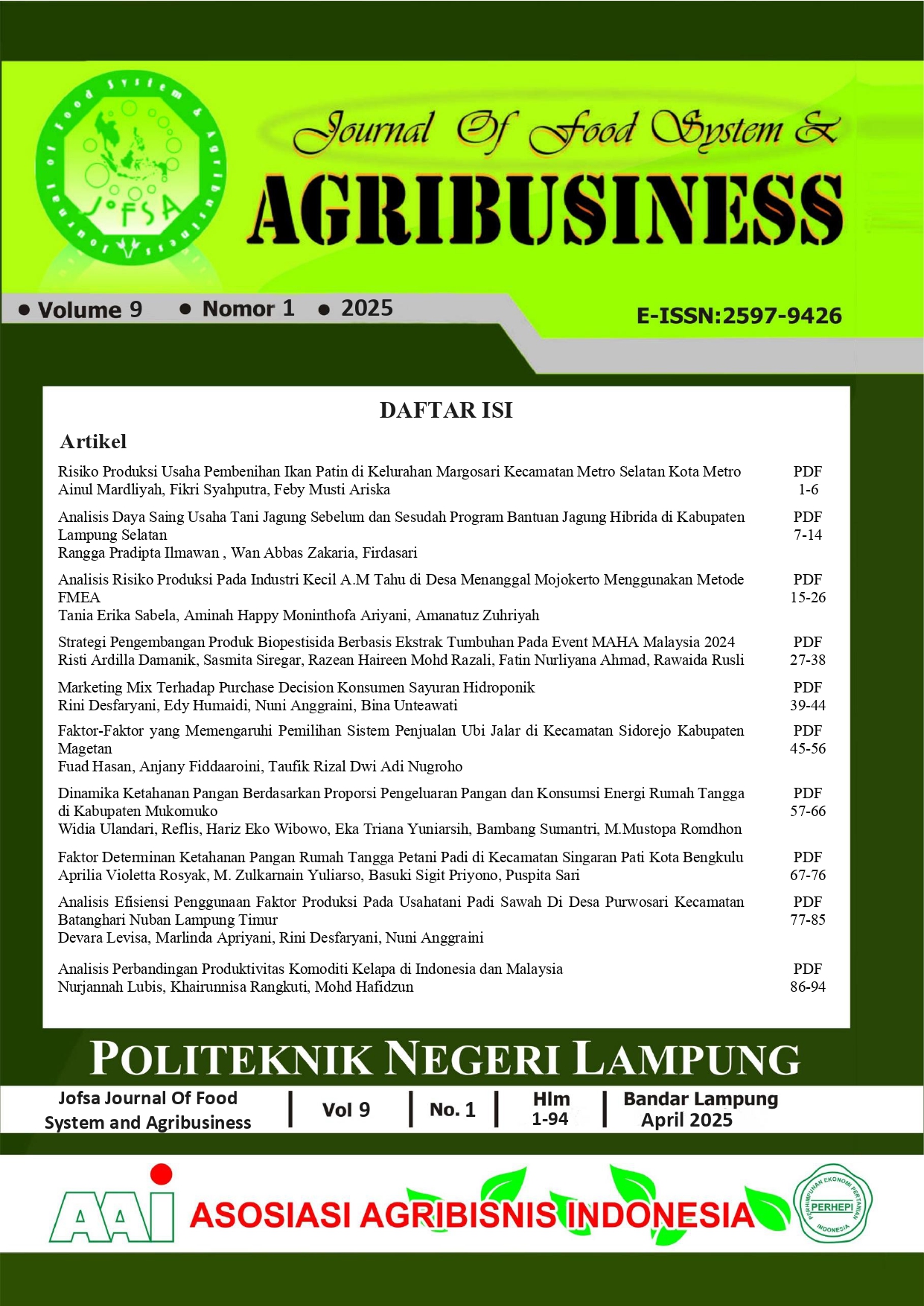
Dinamika Ketahanan Pangan Berdasarkan Proporsi Pengeluaran Pangan dan Konsumsi Energi Rumah Tangga di Kabupaten Mukomuko
DOI:
https://doi.org/10.25181/jofsa.v9i1.4018Keywords:
Dynamics, Consumption, Proportions, HouseholdsAbstract
The purpose of this research was to analyze the proportion of food expenditure, household energy consumption, household food security, and the significant differences in the proportion of household expenditure and energy consumption between the years of 2021 and 2022, 2021 and 2023, and 2022 and 2023 in Mukomuko Regency. The method used was quantitative descriptive, including expenditure analysis, food expenditure proportion analysis, energy consumption, and independent t-test. The research results showed that in 2021-2022, the proportion of household food expenditures was greater than that of non-food expenditures. However, in 2023, the proportion of expenditure on non-food needs increased, causing the proportion of food expenditure to decrease. Household energy consumption in 2021, 2022, and 2023 mostly falls into the good and moderate categories. Household food security in 2021, 2022, and 2023 falls into the food secure category, with 47.64 percent in 2021, 48.42 percent in 2022, and 54.88 percent in 2023. The test results between 2021 and 2022 showed no significant difference in the proportion of food expenditure and household energy consumption between 2021 and 2023. For the proportion of food expenditure, there is a substantial difference between the proportion of household food expenditure between 2021 and 2023, whereas there is no significant difference in household energy consumption between 2021 and 2023. However, between the years 2022 and 2023, there is a substantial difference between the proportion of food expenditure and household energy consumption.
Downloads
References
Achmad, F., Mulyo, J. H., Masyhuri, M., & Subejo, S. (2019). Ketahanan Pangan Rumah Tangga Peternak Sapi Potong Rakyat di Daerah Istimewa Yogyakarta, Indonesia. Jurnal Ketahanan Nasional, 25(2), 151. https://doi.org/10.22146/jkn.45620
Apriyanto, M., & Rujiah. (2021). Analisis Tingkat Ketahanan Pangan Terhadap Kerawanan Pangan Menggunakan Metode Gis (Geographic Information System). Journal of Food System and Agribusiness, 5(1), 54–61. https://doi.org/10.25181/jofsa.v5i1.1976
Arijatmiko, W. (2016). The Effect of Game Instruction Method and Cognitive Style on Learning Outcomes in Arts and Culture of Senior High School Student. Proceedings of International Research Clinic & Scientific Publications of Educational Technology, 660–671.
Badan Ketahanan Pangan. (2020). Analisis Ketersediaan Pangan: Neraca Bahan Makanan Indonesia 2018-2020. Kementerian Pertanian, 1–35. Diambil dari http://bkp.pertanian.go.id/storage/app/media/2021/NBM 2021_ Fix.pdf
Badan Ketahanan Pangan. (2021). Indeks Ketahanan Pangan 2021. In Ministry of Agriculture (Vol. 0).
BPS [Badan Pusat Statistik]. 2024. https://mukomukokab.bps.go.id/indicator/156/98/1/pdrb-kabupaten-mukomuko-atas-dasar-harga-berlaku-menurut-pengeluaran-juta-rupiah-.html2024. [05 Agustus 2024].
BPS [Badan Pusat Statistik]. 2024. https://bengkulu.bps.go.id/id/statistics-table/2/MTA2IzI=/luas-panen-produktivitas-dan-produksi-padi.html. [28 Oktober 2024]
BPS[Badan Pusat Statistik]. 2024. https://mukomukokab.bps.go.id/id/publication/2024/04/30/abb07e2c3f0cf062cf47b8c6/produk-domestik-regional-bruto-kabupaten-mukomuko-menurut-pengeluaran-2019-2023.html. [28 Oktober 2024].
BPS[Badan Pusat Statistik]. 2024. https://bengkulu.bps.go.id/id/statistics-table/1/NDQ2IzE=/rata-rata-konsumsi-kalori--kkal--dan-protein--gram--per-kapita-sehari-penduduk-kabupaten-mukomuko-menurut-kelompok-makanan--maret--2020.html. [28 Oktober 2024].
Dewanti, S. (2020). Keragaman Konsumsi Pangan Rumah Tangga di Provinsi Jawa Tengah. Jurnal Kawistara, 10(3), 282. https://doi.org/10.22146/kawistara.46787
Dudi Septiadi, Andi Iva Mundiyah, & Ni Made Wirastika Sari. (2020). Pengaruh Harga Dan Karakteristik Konsumen Terhadap Permintaan Tempe Di Kota Mataram. dwijenAGRO, 10(2), 117–126. https://doi.org/10.46650/dwijenagro.10.2.1033.117-126
Hendriwinata, M. R., Marwanti, S., & Rahayu, W. (2023). Analisis Ketahanan Pangan Berdasarkan Proporsi Pengeluaran Pangan dan Konsumsi Energi Rumah Tangga di Kabupaten Magelang. Agrista, 11(4), 24–33.
Ilham, N., & Bonar, D. A. N. (1980). Penggunaan Pangsa Pengeluaran Pangan Sebagai Indikator Komposit Ketahanan Pangan. (1996), 1–22.
Illahi et al. (2018). Analisis Determinan Pengeluaran Konsumsi Rumah Tangga Di Indonesia. 1(3), 549–556.
Kementerian Kesehatan (KEMKES). 2025. http://hukor.kemkes.go.id/uploads/produk_hukum/PMK_No__28_Th_2019_ttg_Angka_Kecukupan_Gizi_Yang_Dianjurkan_Untuk_Masyarakat_Indonesia.pdf. [12 Januari 2025].
Magdalena, R., & Angela Krisanti, M. (2019). Pengujian Independent Sample T-Test di PT.Merck, Tbk. Jurnal Tekno, 16(2), 35–48.
Mantouw, S., Sopamen, J., & Papilaya, F. (2024). Analisis Ketahanan Pangan RumahTangga Petani Berdasarkan Pola Konsumsi Pangan. Student Research Journal, 2(2), 1–7.
Maxwell, D., Levin, C., Armar-Klemesu, M., Ruel, M., Morris, S., & Ahiadeke, C. (2000). Urban livelihoods and food and nutrition security in Greater Accra, Ghana. In Research Report of the International Food Policy Research Institute. https://doi.org/10.2499/0896291154rr112
Muhlis, A., Yekti, G. I. A., & Hasan, M. M. (2023). Analisis Ketahanan Pangan Rumah Tangga Petani Sorgum Di Kabupaten Situbondo. Jurnal Pertanian Cemara, 20(2), 1–8. https://doi.org/10.24929/fp.v20i2.3031
Pradnyadewi, N. P. R., Darmawan, D. P., & Arisena, G. M. K. (2021). Ketahanan Pangan Rumah Tangga Petani di Subak Sembung Pada Saat Pandemi Covid-19. Jurnal Manajemen Agribisnis, 9(1), 346–356.
Praza, R., & Shamadiyah, N. (2020). Analisis Hubungan Pengeluaran Dengan Ketahanan Pangan Rumah Tangga Petani Di Kabupaten Aceh Utara. Agrifo : Jurnal Agribisnis Universitas Malikussaleh, 5(1), 23. https://doi.org/10.29103/ag.v5i1.2735
Rahmawati, A., Marwanti, S., & Barokah, U. (2023). Analisis Ketahanan Pangan Dan Korelasi Pengeluaran Pangan DenganKonsumsi Energi Dan Protein Rumah Tangga Petani Padi Sawah DiKabupaten Sragen. Jurnal Ekonomi Pertanian dan Agribisnis (JEPA), 7(4), 1223–1231. Diambil dari https://doi.org/10.21776/ub.jepa.2023.007.04.3
Sari, N. A. (2017). Ketahanan Pangan Tingkat Rumah Tangga Perkotaan Dan Pedesaan Di Kabupaten Kutai Kartanegara. Jurnal Ekonomi & Manajemen Indonesia, 17(1), 8–17. https://doi.org/10.53640/jemi.v17i1.411
Siregar, F. R., Martianto, D., & Tanziha, I. (2023). Analisis pengeluaran pangan dan non pangan, pola konsumsi, dan asupan energi dan protein di provinsi jawa timur sebelum dan selama pandemi Covid-19. Jurnal SAGO Gizi dan Kesehatan, 5(1), 1. https://doi.org/10.30867/gikes.v5i1.1188
Sophia, Erwandri, E., Dewi, R., & Varina, F. (2022). Analisis Tingkat Ketahanan Pangan Keluarga Penerima Manfaat Bantuan Sosial Pangan (Kpm Bansos Pangan) Di Kabupaten Batang Hari. JAS (Jurnal Agri Sains), 6(2), 113–121. https://doi.org/10.36355/jas.v6i2.920
Sumarni, Ayu, C., & Tajidan. (2020). Analysis of Household Food Security Level of Irrigated Rice Farmers in Cendi Manik Village in Sekotong Sub-District of West Lombok District. 21(2), 133–147.
Susanto, D., Uchyani, R., & Irawan, E. (2022). Analisis Ketahanan Pangan Rumah Tangga Petani Padi Berdasarkan Proporsi Pengeluaran Pangan Dan Konsumsi Energi Di Kecamatan Cawas Kabupaten Klaten. Agrista, 10(3), 65–74.
Utami, I. R. P., Wahyuningsih, S., Awami, S. N., & Subantoro, R. (2021). Analisis Ketahanan Pangan Rumah Tangga Petani Bawang Merah (Allium Cepa L.) Di Kecamatan Mijen Kabupaten Demak. Mediagro, 17(1), 67–79. https://doi.org/10.31942/md.v17i1.4032
Wardani, & Yuliawati. (2020). Pangan Rumah Tangga Di Kota Salatiga Pada Masa Pandemi Covid-19 The Influence Of Socioeconomic Conditions On The Household Food Security Level In Salatiga During Covid-19 Pandemic. Jurnal Ilmiah Mahasiswa AGROINFO GALUH, 10, 360–369.
Wityasari, N. S. (2021). Pengertian Ketahanan Pangan Aspek, Tujuan dan Faktor yang Mempengaruhi. Staf Dinas Ketahanan Pangan Kab Probolinggo, (1997).
Downloads
Published
How to Cite
Issue
Section
License
Copyright (c) 2025 Journal of Food System and Agribusiness

This work is licensed under a Creative Commons Attribution-NonCommercial 4.0 International License.
Authors who publish with Journal of Food System and Agribusiness (JoFSA) agree to the following terms:
Authors retain copyright and grant the Journal of Food System and Agribusiness (JoFSA) right of first publication with the work simultaneously licensed under a Creative Commons Attribution License (CC BY-SA 4.0) that allows others to share (copy and redistribute the material in any medium or format) and adapt (remix, transform, and build upon the material for any purpose, even commercially) with an acknowledgment of the work's authorship and initial publication in Journal of Food System and Agribusiness (JoFSA).
Authors are able to enter into separate, additional contractual arrangements for the non-exclusive distribution of the journal's published version of the work (e.g., post it to an institutional repository or publish it in a book), with an acknowledgment of its initial publication in Journal of Food System and Agribusiness (JoFSA). Authors are permitted and encouraged to post their work online (e.g., in institutional repositories or on their website) prior to and during the submission process, as it can lead to productive exchanges, as well as earlier and greater citation of published work.