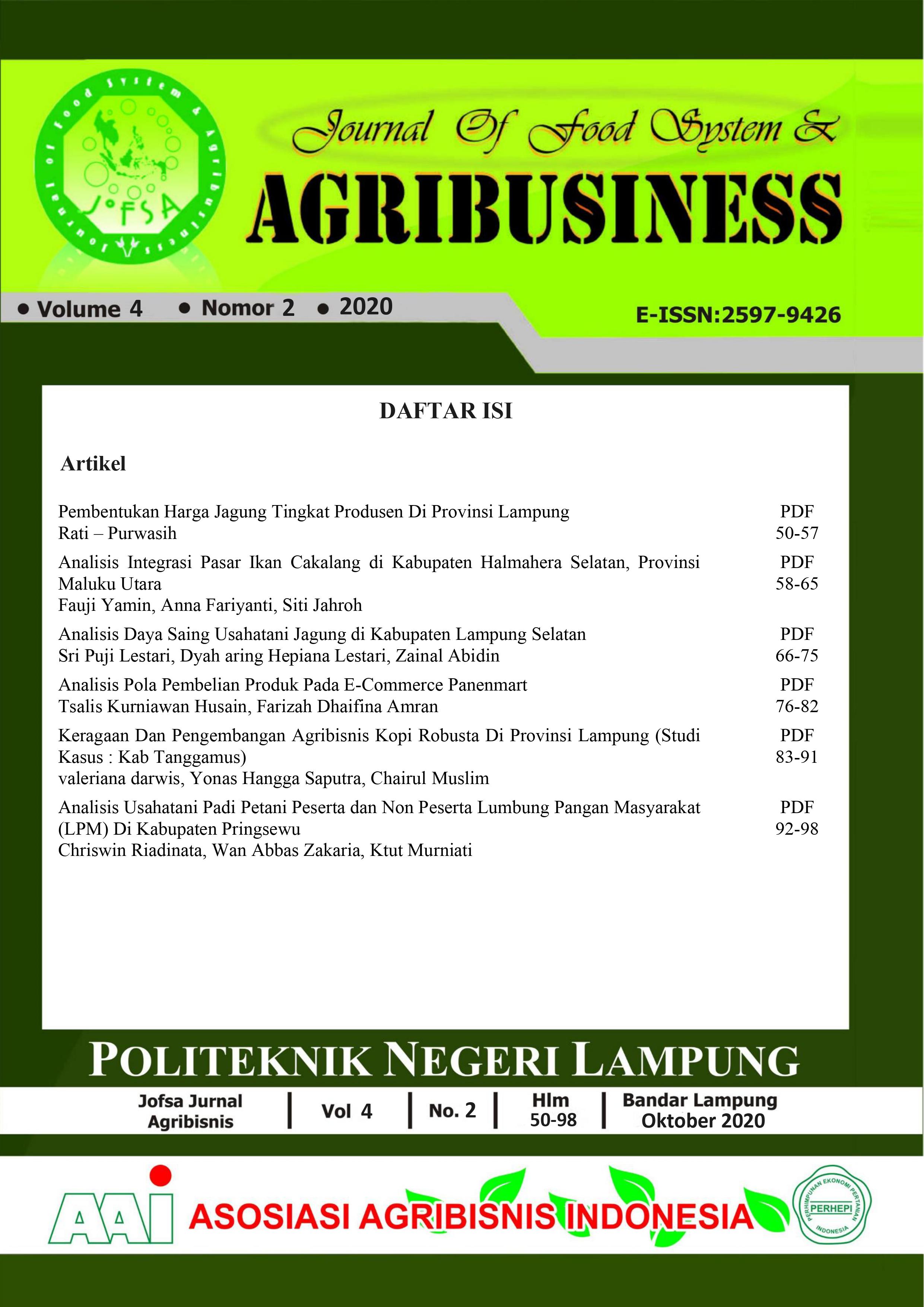
Keragaan Dan Pengembangan Agribisnis Kopi Robusta Di Provinsi Lampung (Studi Kasus : Kab Tanggamus)
DOI:
https://doi.org/10.25181/jofsa.v4i2.1649Abstract
Lampung Province is one of the Robusta coffee agribusiness centers that is included in the development area of the coffee area contained in the Decree of the Minister of Agriculture No. 472 of 2018. Based on this stipulation, this paper aims to determine the production system, maintenance costs and supply chain in Lampung Province. The survey was conducted in July 2019 with data collection methods through FGD and direct interviews with farmers using a questionnaire. From the results of a qualitative descriptive analysis and maintenance cost, it was found that the Robusta coffee agribusiness in Lampung Province experienced positive growth. This is represented by an increase in coffee selling price of 0.39% / year, planting area of 0.33% / year and production of 0.09% / year. But in terms of productivity, respondents' farmers only produce 593 kg / year or still low compared to national productivity of 656 kg / year and Lampung province productivity of 800 kg / year. The low productivity of respondent farmers was caused by: (i) lack of motivation to maintain because the maintenance costs per kg (Rp. 4,013) were lower than the selling price of coffee (Rp. 18,000); (ii) the age of the plant is old and (iii) it is not the main crop. Coffee agribusiness in Lampung Province can still be improved by: (i) increasing productivity through the application of coffee-based cultivation; (ii) making demonstration plots at farmer locations as an effort to disseminate research results from the Ministry of Research and Development; (iii) rebuilding institutions especially in overcoming the problems of production, marketing and processing of products and (iv) making partnerships with traders or roasteries so that farmers no longer need to sell as origin seeds
Downloads
References
BPS. 2018. Statistik Indonesia Tahun 2018
Fizanty T, Kusnandar. 2012. Pengelolaan logistik dalam rantai pasok produk pangan segar di Indonesia. Jurnal Penelitian Pos dan Informatika. Hal 16-33.
Ling Li. 2007. Supply Chain Management: Concep, Techiniques and Pratices Enhancing Value Through Collaboration. World Scientific Publishing. Co.Pte. Lted, Singapore.
Mulyadi. 2007. Akuntasi Biaya. Sekolah Tinggi Ilmu Manajemen YKPN. Yogyakarta.
Nazir, M. 1988. Metode Penelitian, Ghalia Indonesia: Jakarta.
Nalurita S, R W Asmarantaka dan S Jahroh. 2014. Analisis Daya Saing dan Strategi Pengembangan Agribisnis Kopi Indonesia. Jurnal Agribisnis Indonesia Vol 2 No 1 Hal.63-74
Panggabean, Edy. 2011. Buku Pintar Kopi. PT. AgroMedia Pustaka. Jakarta.
Prastowo, Bambang, Elna Karmawati, Rubijo, Siswanto, Chandra Indrawanto, S. Joni Munarso. 2010. Budidaya dan Pasca Panen Kopi. Pusat Penelitian dan Pengembangan Perkebunan. Bogor
Pusdatin Kementan. 2018. Ekspor Komoditi Pertanian Berdasarkan Negara Tujuan. http://database. pertanian.go.id/ eksim2012asp/eksporNegara.asp [diakses 2018 Sept 23]
Rexsi Nopriyandi dan Haryadi. 2017. Analisis Ekspor Kopi Indonesia. Jurnal Paradigma Ekonomi Vol 12 No 1.
Rubioyo, Hermanto, C Indrawanto, M Yusron, V Darwis, T Anggraeni, K Hadiutomo dan Y Nurcahya. 2019. Pemetaan dan Reviu Proses Bisnis Perencanaan Wilayah Perkebunan Kopi di Indonesia. Biro Perencanaan Kementerian Pertanian
Roekel, JV, Willems, S & Boselie, DM 2002, Agri-Supply Chain Management : To Stimulate Cross Border Trade in Developing Countries and emerging Economies,
Sulastriningsih dan Zulkifli.1999. Akuntansi Biaya. Seolah Tinggi Ilmu Manajemen YKPN. Yogyakarta.
Sugiyono. 2005. Metode Penelitian Administrasi. Bandung: Alfabeta
Whitney, F. 1960. The Element Of Research. New York :Prentice-Hall, Inc
Downloads
Published
How to Cite
Issue
Section
License
Copyright (c) 2020 Journal of Food System & Agribusiness

This work is licensed under a Creative Commons Attribution-NonCommercial 4.0 International License.
Authors who publish with Journal of Food System and Agribusiness (JoFSA) agree to the following terms:
Authors retain copyright and grant the Journal of Food System and Agribusiness (JoFSA) right of first publication with the work simultaneously licensed under a Creative Commons Attribution License (CC BY-SA 4.0) that allows others to share (copy and redistribute the material in any medium or format) and adapt (remix, transform, and build upon the material for any purpose, even commercially) with an acknowledgment of the work's authorship and initial publication in Journal of Food System and Agribusiness (JoFSA).
Authors are able to enter into separate, additional contractual arrangements for the non-exclusive distribution of the journal's published version of the work (e.g., post it to an institutional repository or publish it in a book), with an acknowledgment of its initial publication in Journal of Food System and Agribusiness (JoFSA). Authors are permitted and encouraged to post their work online (e.g., in institutional repositories or on their website) prior to and during the submission process, as it can lead to productive exchanges, as well as earlier and greater citation of published work.