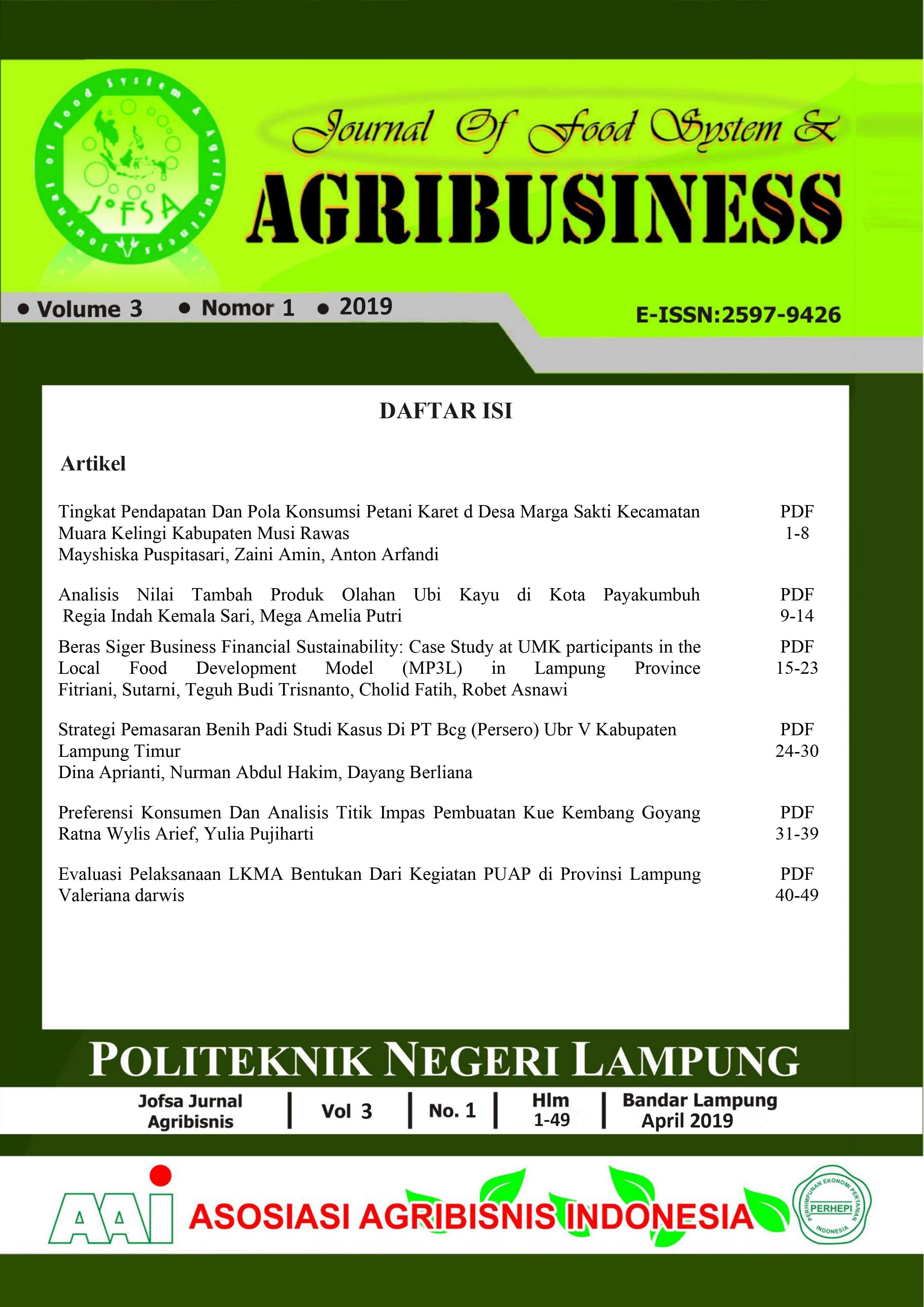
Preferensi Konsumen dan Analisis Titik Impas Pembuatan Kue Kembang Goyang
DOI:
https://doi.org/10.25181/jofsa.v3i1.1411Abstract
Shake flower cookies is a type of traditional Indonesian cookies made from rice flour. Processing rice groats into rice groats flour and using it as a raw material for making shake flower cookies aims to increase the added value of rice groats which has only been used as animal feed. The research was conducted in Ponco Kresno Village, Negeri Katon Subdistrict, Pesawaran District, from September to December 2016. The treatment applied was the difference in the composition of flour used, namely: A = 100% Rose Brand rice flour ; B = rice groats flour 90% + tapioca flour 10%; C = rice groats flour 80% + tapioca flour 20%; and D = rice groats flour 100%. The results showed that treatment C (rice groats flour 80% + tapioca flour 20%) could be developed for entrepreneurial shake flower cookies, because statistically it did not show a significant difference in color, taste, crispness, and general acceptance compared to the use of rose brand rice flour 100%, and the capital needed is the lowest compared to other treatments, which is only Rp. 4,860, - / pack, while the price of the selling shake flower cookies on the market for all treatments is the same, Rp. 9,000, - / pack, so that the benefits obtained by farmers when using treatment C are higher than other treatments.
Downloads
References
Asnawi, R. (2014). Peningkatan Produktivitas dan Pendapatan Petani Melalui Penerapan Model Pengelolaan Tanaman Terpadu Padi Sawah di Kabupaten Pesawaran, Lampung. Jurnal Penelitian Pertanian Terapan, 14(1), 44–52. https://doi.org/10.25181/jppt.v14i1.141
Astuti, E. (1986). Karakterisasi Tepung Beras Menir Pragelatinisasi dan Perubahan Mutunya Selama Penyimpanan (Vol. 3).
Auliah, A. (2012). Formulasi Kombinasi Tepung Sagu dan Jagung pada Pembuatan Mie Combination Formulating of Sago Palm and Corn Flour to Noodle Manufacturing. Jurnal Chemica, 13(2), 33–38.
De Datta, S. K. (1981). Principles and Practices of Rice Production. In A WILEY-INTERSCIENCE PUBLICATION.
Fuadah, IE dan Anna, C. (2016). Pengaruh Penambahan Tepung Bekatul Terhadap Mutu Organoleptik Kue Kembang Goyang. Jurnal Tata Boga, 5(3), 18–26.
Handayani, S., Affandi, M. I., & Astuti, S. (2018). Analisis Karakteristik Mutu Beras Organik Varietas Mentik Susu Dan Sintanur. Journal of Food System and Agribusiness, 2(2), 75–82.
Hidayah, Nur Lailatul dan Anna, C. (2019). Pengaruh Subsitusi Tepung Tempe Dan Penambahan Margarin Terhadap Mutu Organoleptik Kue Kembang Goyang. 8(I), 23–31.
Iswanto, PH, Akbar, ARM , dan Rahmi, A. (2018). PENGARUH KADAR AIR GABAH TERHADAP MUTU BERAS PADA VARIETAS PADI LOKAL SIAM SABAH Pangestu. JTAM Inovasi Agroindustri, 1(1), 12–23.
Movanita, A. (2018). Akhir 2018, Produksi Padi Indonesia Diprediksi 56,54 Juta Ton. KOMPAS, Https://Ekonomi.Kompas.Com/Read/2018/10/24/134313026/Akhir-2018-Produksi-Padi-Indonesia- Diprediksi-5654-Juta-Ton.
Oktavia, D. (2007). Kajian SNI 01-2886-2000 Makanan Ringan Ekstrudat. Jurnal Standardisasi, 9(1), 1–9. https://doi.org/10.31153/js.v9i1.8
Prakasa, Y., Sumarwan, U, dan Bawono, S. (2010). Analisis Pengaruh Butir Patah Dan Menir Terhadap Penjualan Beras Premium Di Pasar Induk Beras Cipinang. PANGAN, 19(4), 383–397.
Rachmat, R. dan S. (2011). Model Penggilingan Padi Terpadu Untuk Meningkatkan Nilai Tambah. PANGAN, 20(3), 315–330.
Sarifudin, A., Ekafitri, Ri, Surahman, D.N., dan P. (2015). Pengaruh Penambahan Telur Pada Kandungan Proksimat , Karakteristik Aktivitas Air Bebas (Aw) Dan Tekstural Snack Bar Berbasis Pisang (Musa paradisiaca). AGRITECH, 35(1), 1–8.
Tyas E.W.D. (2015). Pengaruh Jenis Cairan Dan Jumlah Puree Wortel (Daucus Carota) Terhadap Sifat Organoleptik Kue Kembang Goyang. E-Journal Boga, 4(1), 80–89.
Ulfah, D. (2015). Pengaruh Penggunaan Jenis Gula Terhadap Kualitas Kue Kembang Goyang Tepung Kacang Hijau.
Wariyah, C. (2010). Restrukturisasi Menir Menjadi Beras Berkalsium Tinggi Dengan Metode Ekstrusi Restructured. 30(3), 135–140.
Widowati, S. (2001). Pemanfaatan Hasil Samping Penggilingan Padi dalam Menunjang Sistem Agroindustri di Pedesaan. Buletin AgroBio, 4(1), 33–38.
Downloads
Published
How to Cite
Issue
Section
License
Authors who publish with Journal of Food System and Agribusiness (JoFSA) agree to the following terms:
Authors retain copyright and grant the Journal of Food System and Agribusiness (JoFSA) right of first publication with the work simultaneously licensed under a Creative Commons Attribution License (CC BY-SA 4.0) that allows others to share (copy and redistribute the material in any medium or format) and adapt (remix, transform, and build upon the material for any purpose, even commercially) with an acknowledgment of the work's authorship and initial publication in Journal of Food System and Agribusiness (JoFSA).
Authors are able to enter into separate, additional contractual arrangements for the non-exclusive distribution of the journal's published version of the work (e.g., post it to an institutional repository or publish it in a book), with an acknowledgment of its initial publication in Journal of Food System and Agribusiness (JoFSA). Authors are permitted and encouraged to post their work online (e.g., in institutional repositories or on their website) prior to and during the submission process, as it can lead to productive exchanges, as well as earlier and greater citation of published work.